

When a wheel-off accident happens in Texas, it’s not always easy to tell who’s responsible. A tire or wheel usually doesn’t come loose unless something went wrong, but the cause may not be clear right away.
More than one person or company may have played a part.
Texas law allows fault to be split among multiple parties, and that split can affect how much an injured person can recover.
Keep reading to learn how Texas handles shared fault, how partial blame can affect compensation, who may be held responsible, and how insurers try to limit payouts.

Texas uses a modified comparative negligence system in personal injury cases. That means each party can be assigned a percentage of fault.
In a wheel-off accident, one party may be mostly responsible, while others still share part of the blame. For example, a repair shop may have improperly tightened the lug nuts. The vehicle owner may have ignored shaking or pulling before the crash. And another driver may have made things worse by speeding or following too closely.
Under Texas law, you can still recover compensation as long as you’re not more than 50 percent at fault. If you’re 50 percent at fault or less, you may still have a claim. But if you’re 51 percent or more at fault, you can’t recover compensation from other responsible parties.
That 1 percent difference can be huge.
This is why fault percentages become such a big fight. The other side doesn’t have to prove you were completely at fault for the crash. They only need to push enough blame onto you to reduce or block your recovery.
Can You Recover Compensation If You Were Partly at Fault?
Yes. You can still recover compensation in a wheel-off accident if you were partly responsible, as long as your share of the fault is 50 percent or less.
Your compensation will be reduced by your percentage of fault. Consider a case where your damages are valued at $1 million. If you’re found to be 20 percent at fault, your recovery would be reduced by 20 percent. That would leave you with $800,000.
This may sound simple, but it doesn’t usually turn out to be that way. Insurance companies know how powerful shared fault arguments can be. They may argue that you were driving too fast, waited too long to get medical care, didn’t take steps to avoid the crash, or should have noticed a problem sooner.
Some of these claims may be weak. Some of them might be flat-out unfair. But if no one pushes back, those arguments can stick.
Partial fault can also come up when the injured person owns the vehicle that lost a wheel. The insurance company may dig into the maintenance records, past repairs, warning signs, tire changes, or inspection history. That doesn’t automatically mean that the owner caused the accident. It means the facts need to be explained clearly before the insurer twists them.
The strongest claims show what each party knew, what they should have done, and what they failed to do.
How Is Fault Divided in a Texas Wheel-Off Accident?
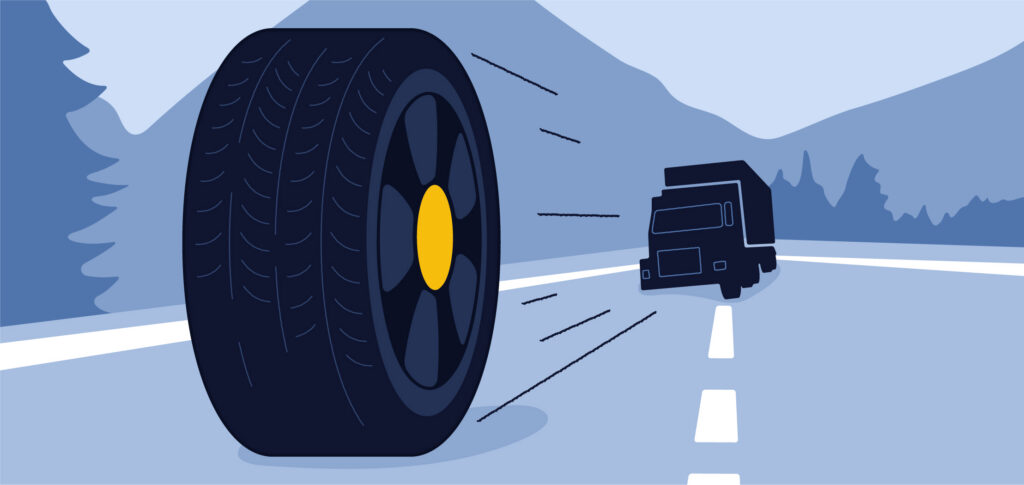
Texas law allows fault to be divided among multiple responsible parties in a wheel-off accident. Rather than placing all responsibility on one defendant, a court or jury may assign each party a percentage of fault based on the evidence.
This process often becomes one of the most heavily contested parts of the case. Each defendant has a financial incentive to argue that another party bears greater responsibility for the wheel separation. A repair shop may blame the manufacturer, while the manufacturer blames improper installation. A trucking company may point to an outside maintenance contractor.
These disputes become even more complicated when one potentially responsible party has limited assets or is difficult to pursue in a U.S. court. If the remaining defendants successfully shift more fault to that party, they may reduce their own financial responsibility, leaving the injured person with less compensation than they might otherwise recover.
Insurers often use shared fault arguments to lower payouts after a wheel-off accident. Their goal is simple: pay less.
When multiple insurers are involved, each one typically tries to minimize its own policyholder’s responsibility. A repair shop’s insurer may blame the parts manufacturer. A manufacturer’s insurer may argue the wheel was installed incorrectly. A trucking company’s insurer may point to an outside maintenance provider. This finger-pointing can delay the claim and complicate the injured person’s recovery.
This finger-pointing can delay the claim, complicate settlement negotiations, and affect how much each defendant ultimately pays.
The cause of a wheel separation is rarely obvious immediately after a crash. What appears to be a simple mechanical failure may ultimately be traced to improper repairs, inadequate maintenance, a defective component, or another issue uncovered through a thorough investigation. Until those facts are established, insurers may use incomplete information to support their own version of events.
An experienced attorney can keep the insurer from building a false story around incomplete facts. They can pinpoint the responsible parties, protect evidence, and challenge unfair blame before it damages the claim.
What Evidence Determines Fault in a Wheel-off Accident?

Fault in a wheel-off accident is determined through evidence. Opinions are never enough. The proof has to show what failed, why it failed, and who had a duty to prevent it.
Police reports can help because they may include crash details, witness names, vehicle positions, and basic findings. But they usually don’t explain the full mechanical cause of a wheel separation.
Photos and videos can also be useful. Pictures of the vehicle, tire, wheel assembly, lug nuts, studs, hub, roadway, debris field, and damage patterns may show how the accident happened. Helpful information may also be found through dash camera footage, business cameras, and traffic cameras.
Witness statements can fill in details that don’t show up in a report. Someone may have seen the wheel wobble before it came off. Another person may have noticed sparks, smoke, swerving, or sudden debris on the road.
Maintenance and repair records are vital in wheel-off accident cases. These records can show who worked on the vehicle, what repairs were done, whether complaints were made, and whether earlier wheel problems existed. Missing or sloppy records can raise serious questions.
Expert analysis may also be needed. Accident reconstruction experts can study speed, movement, impact angles, and the crash sequence. And mechanical experts can inspect the wheel parts and explain whether the failure came from poor repair work, worn components, bad parts, or lack of maintenance.
Medical records also matter because they link your injuries to the accident. Insurance companies may argue that your injury came from something else. Clear treatment records help to show how the crash has affected you and how serious your injuries are.
The vehicle, wheel, and any related parts should be preserved whenever possible. Once evidence is repaired, thrown away, or lost, the case gets harder to prove. That’s why it’s smart to act quickly after a wheel-off accident.
Contact Grossman Law Offices After a Wheel-off Accident
If you or a loved one was hurt in a wheel-off accident involving multiple at-fault parties, don’t let the insurance companies control the story. You need clear answers, strong evidence, and someone who knows how to deal with blame-shifting before it hurts your case. You need a seasoned lawyer or attorney.
Grossman Law Offices has handled serious Texas injury cases for more than three decades. Our law firm understands how shared fault works and how quickly insurers may try to use it against accident victims. When they start pointing fingers, we know how to push back.
Contact Grossman Law Offices today if you need help after a wheel-off accident. We’re ready to explain your rights, protect your claim, and fight for the full compensation the law allows.

 Lláma
Lláma  Correo
  Mensaje