

If you were hurt in a wheel-off accident in Texas, you may be thinking, “What if I was partly at fault?”
That’s a common fear after a serious crash. You may be replaying the accident in your head, wondering whether you could have reacted faster, slowed down sooner, or made a different choice in the moment. Insurance companies may also try to make you feel like one mistake ends the entire case.
But here’s the truth: being partially at fault doesn’t always mean you’re out of options.
Texas law may still allow you to seek compensation, even if you played a part in the crash. The real question is how much fault belongs to you and how much belongs to everyone else.
Wheel-off accidents can raise difficult questions about responsibility. The answer may depend on what happened before, during, and after the crash. It may also depend on who had control over the vehicle, who worked on it, and what facts can be proven.
Read on to learn what happens if you were partly at fault in a Texas wheel-off crash.
Texas Uses a Modified Comparative Fault Rule

Texas uses a modified comparative fault rule in wheel-off accident cases. In simple terms, the law looks at how much blame belongs to each person or company involved.
That means your case doesn’t fall apart just because you made a mistake. Maybe you were driving a little too fast. Maybe you didn’t react as quickly as you wish you had. That doesn’t automatically erase everyone else’s role in the crash.
When a wheel comes off a vehicle, it’s for a reason. A driver might feel shaking or hear strange noises and keep going. The company responsible for the vehicle might put safety checks on the back burner. Poor repair work can turn a simple wheel service into a serious danger. During maintenance, worn parts are sometimes overlooked. In other cases, the problem starts with a defective part that never should have been used.
That’s why these cases need a closer look. A wheel-off crash may involve choices made long before the accident, including missed inspections, rushed repairs, ignored warning signs, or failure to replace worn equipment. Those details can change how fault is divided. The insurance company may focus only on what you did in the seconds before the crash, but the story often starts much earlier.
The point is that fault isn’t always simple. Texas law looks at each person’s role separately instead of placing all the blame on one person right away.
Can You Still Recover Money in a Wheel-off Accident?
Yes, you can still recover compensation after a wheel-off accident, but only if you’re found to be 50% or less at fault. And any recovery will be reduced based on your share of responsibility.
Let’s say your losses total $100,000 after a wheel-off crash. If you’re found 25% at fault, your compensation would be reduced by 25%. That means you would still recover $75,000.
Even if you didn’t make the best decisions behind the wheel, it doesn’t excuse everyone else’s unsafe choices. A trucking company, repair shop, maintenance provider, parts maker, or vehicle owner may still share responsibility for allowing an unsafe vehicle on the road.
If you are partly at fault, you may not take home as much compensation as you might have otherwise. But that doesn’t mean you should walk away from your claim. There may still be strong evidence that another driver, company, repair shop, or maintenance provider is also to blame.
Who Decides Fault in a Wheel-off Accident Case?
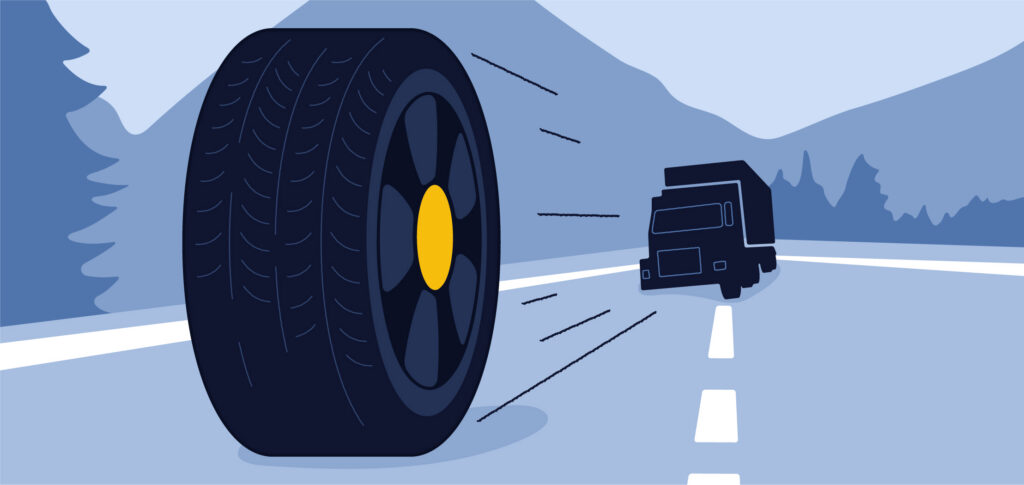
In many cases, fault is first discussed by insurance adjusters. These professionals work for insurance companies, and their job often involves finding reasons for the insurer to pay less. They may review a claim, speak with the people involved, and make an early decision about fault. But their opinion is not the final word.
Attorneys can also play an important role in how fault is evaluated. A lawyer can gather evidence, question the insurance company’s version of events, bring in experts when needed, and explain why more than one person or company may be responsible.
If the case doesn’t settle, fault may ultimately be decided in court. A judge or jury can review the evidence and decide how responsibility should be divided among the injured person, the driver, the vehicle owner, the trucking company, a repair shop, or another responsible party.
Evidence and fault go hand in hand in a wheel-off accident case. Before anyone can fairly decide who was responsible, they need to understand what happened, what caused the wheel to come off, and whether more than one person or company played a role.
Evidence may include police reports, photos, videos, witness statements, maintenance records, inspection logs, repair history, and damaged parts from the vehicle.
Police reports can be helpful because they include basic facts about the crash, the officer’s observations, statements from people at the scene, citations, and notes about road or weather conditions. Just know that a police report may not tell the whole story. Officers usually arrive after the accident. They may not know whether the truck was poorly maintained, whether a repair shop made a mistake, or whether a company ignored earlier warning signs.
Maintenance and repair records can be especially important. They may reveal whether the truck was serviced on time, whether parts were inspected, and whether known problems were fixed. They can also point to issues after a recent wheel service, loose or poorly tightened lug nuts, and worn parts that should’ve been replaced.
Inspection logs can tell you if the vehicle was checked before it went back on the road. Missing, rushed, or incomplete logs may raise questions about how seriously a company takes safety.
Photos, videos, and witness statements also matter. They can show the vehicles, road conditions, debris, damaged parts, and how fast things unfolded.
This evidence paints a full picture of the accident and what really caused the wheel to come off. It also shows how much time the injured person had to avoid the crash. Remember: fault decisions should be based on evidence, not on pressure from an insurance company.
Can Insurance Companies Reduce Your Wheel-off Accident Claim?
Yes, insurance companies can try to reduce your wheel-off accident claim by arguing that you were partly at fault. That’s one of the main tactics they use to minimize payouts.
They may use your own words against you. Comments like “I’m sorry,” “I didn’t see it,” or “I should’ve moved faster” may be twisted into admissions of blame.
An adjuster may also ask for a recorded statement. They may sound friendly, but they often ask questions in a way that can easily trip you up. They may ask whether you were tired, distracted, speeding, or following too closely.
They may also focus on small details while ignoring larger safety failures. For example, they might spend more time questioning your reaction time than looking at loose lug nuts, skipped inspections, poor repairs, or worn parts. That can make the claim seem like it’s mostly about your driving, even when the vehicle should never have been on the road in that condition.
Don’t admit fault or guess about what happened. Stick to the facts you know, such as where you were, what you saw, and what you remember. If you aren’t sure about something, it’s okay to say that. You don’t have to fill in the blanks for the insurance company.
A guess can be taken out of context and used against you later. For example, saying you “might have been going too fast” or “maybe could’ve moved sooner” may sound harmless in the moment, but the insurance company may treat it like proof that you caused the crash.
If an insurance company has requested a recorded statement, talk to a lawyer first. They can help you understand what you should answer, how to answer, and how to protect your claim before the insurance company starts shaping the story.
What Steps Help Protect a Wheel-Off Accident Claim?

The best steps are to get medical care, save evidence, collect witness information, and keep records of your losses.
Start with a doctor’s visit. If you’re considering passing on medical treatment, remember that injuries can show up later. Once the adrenaline wears off, pain and other symptoms may become harder to ignore. A doctor can evaluate your injuries, recommend treatment, and explain what warning signs to watch for. Medical treatment also creates records that can help connect your injuries to the accident. If you wait too long, the insurance company may try to argue that you weren’t badly hurt or that something else caused your injuries.
If it’s safe, take photos of the vehicles, loose wheel, debris, skid marks, road conditions, license plates, company names, and visible injuries. These details can disappear as the scene is cleaned up. Photos can help preserve what the crash looked like before vehicles were moved, repairs were made, or damaged parts were lost.
Get witness names and phone numbers whenever possible. A witness may explain how suddenly the wheel came loose and how little time you had to respond. This account can be helpful if the other side tries to say that you could have moved out of the way in time.
Save medical bills, repair estimates, receipts, work notes, prescription records, and proof of missed wages. You should also keep a simple record of your symptoms, appointments, missed workdays, and how the injury affects your daily life. These records show your losses in black and white, which can make them harder to dispute during settlement negotiations or in court.
You should also avoid giving detailed statements to insurance companies before you understand your rights. A lawyer can help protect your claim, preserve important evidence, and stop the other side from twisting your words to their benefit.
Contact Grossman Law Offices After a Wheel-off Accident
If you or a loved one was hurt in a wheel-off accident in Texas, you need a lawyer who will work in your best interests. Grossman Law Offices can help you understand your case value and how to get the compensation you deserve.
For over 35 years, our law firm has handled serious accident and injury cases. We know that insurers often try to pin the entire thing on the victim, even when the facts suggest that someone else was at fault, too. We have the experience, resources, and expertise to guide you through the legal process and keep the other side from taking advantage of you.
At Grossman Law Offices, we don’t treat serious injury cases like routine claims. Our firm handles complex accident, wrongful death, commercial vehicle, dram shop, and workplace injury cases across Texas. These are the kinds of cases that often require more than a quick insurance review. They require careful investigation, strong evidence, and a legal team that knows how to deal with companies and insurers that don’t want to accept responsibility.
Our team of attorneys, paralegals, intake staff, and researchers works together to uncover what happened and help clients get clear answers. We know that after a serious injury or tragic loss, you may be facing medical bills, financial stress, unanswered questions, and pressure from the other side. Our job is to take that burden off your shoulders as much as possible.
Grossman Law Offices is available 24/7, and we offer direct, personalized support throughout the process. When you contact us, we’ll listen to your story, explain your options, and help you understand what to expect. We fight for accountability, justice, and the financial security our clients need to move on with their lives. Contact us today to talk through your wheel-off accident case with an experienced attorney.

 Lláma
Lláma  Correo
  Mensaje