
Sedgewick County, KS — April 29, 2025, two people were injured in a truck accident at about 1:40 p.m. on State Highway 42 north of Viola.
Authorities said a westbound vehicle was knocked into the path of an oncoming semi-truck when it was hit from behind by another vehicle near the intersection with North Grice Street/South 263rd Street West. The truck overturned after the crash.
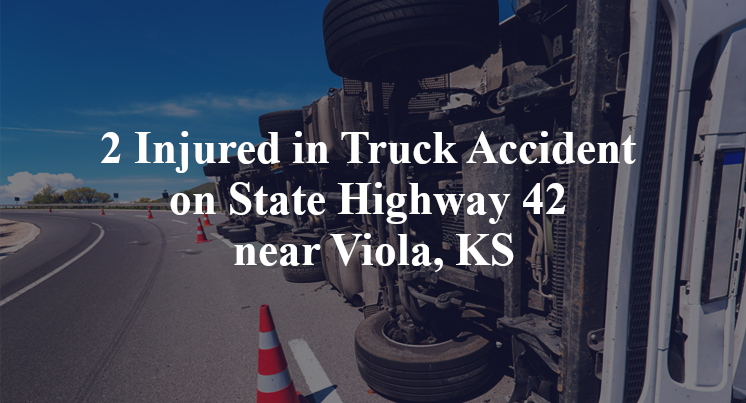
The driver of the westbound vehicle, identified only as a 28-year-old woman from Oklahoma at this time, and an infant passenger were hospitalized with serious injuries after the crash, according to authorities.
The other two drivers suffered minor injuries, but they did not need to be hospitalized, authorities said.
Authorities have not released any additional information about the Sedgwick County crash. The accident is still under investigation.
Commentary by Attorney Michael Grossman
When a vehicle is struck from behind and pushed into the path of a semi-truck, it raises immediate questions about whether each driver involved was operating their vehicle in a manner consistent with the care required under the law, especially in mixed-traffic areas where trucks and passenger vehicles routinely share space. This crash on Kansas Highway 42 illustrates how quickly a lapse in following distance or attention can lead to a multi-vehicle chain of events, particularly when a commercial truck is involved.
The key issue here begins with the rear-end collision. Drivers are expected to maintain enough following distance to stop safely if the vehicle ahead slows or stops. Failing to do so, especially in a way that forces another vehicle into oncoming traffic, often indicates distraction, excessive speed or simply a failure to maintain proper spacing. In this case, that single impact triggered a secondary collision with a semi-truck, which then overturned. That sequence greatly increases the legal exposure for the driver who initiated the chain of events.
At the same time, the truck driver’s role must also be examined. Was the truck traveling at a safe speed? Did the driver have enough time to brake or swerve once the vehicle entered their lane? While the truck appears to have been the last in the sequence, commercial drivers are held to a higher standard and are expected to anticipate potential hazards and respond accordingly, particularly in open-road conditions like those often found in rural Sedgwick County.
The fact that the truck overturned also raises questions about cargo weight, load balance and vehicle speed. Overturns are often the result of high centers of gravity, improper braking techniques or evasive maneuvers made too aggressively. If any part of the truck’s configuration or response contributed to the severity of the crash, that may factor into how liability is assessed.
With two people, one of them an infant, suffering serious injuries, this incident highlights how multiple small decisions by multiple drivers can compound into a high-stakes collision. The legal investigation here must look at each point in that chain: Was the vehicle following too closely? Did the impacted car have functioning signals? Did the truck driver have time and space to react? These are the details that will ultimately determine how responsibility is assigned and what measures could have prevented the crash from escalating to this degree.
In cases involving commercial vehicles, that kind of analysis is not optional; it’s essential. Because once a vehicle is pushed into a truck’s path, the outcome shifts from a typical fender-bender to something far more dangerous, and the law expects all parties, especially those operating commercial equipment, to have done everything within reason to keep that from happening.

 call us
  Email Us
  Text us