

When it comes to road collisions, wheel-off accidents stand out. They aren’t handled like most car crashes because they often stem from several bad decisions.
The questions surrounding normal crashes are pretty familiar: Who ran that red light? Did someone fail to yield? Was someone driving distracted?
Many times, those questions still come up in a wheel-off crash. But they usually don’t go far enough.
A wheel popping off a car, pickup, trailer, or truck is a sign that something went wrong even before the crash. Wheels are supposed to stay attached to a vehicle; when they don’t, it could point to loose lug nuts, failed bearings, or botched repair shop work.
Sometimes, the fault lies with a company that ignored a warning sign. It could also boil down to a defective part.
All of these scenarios affect who can be held responsible, what evidence needs to be saved, and how the case should be investigated. That’s why it’s so important to know the legal difference between wheel-off accidents and car crashes.
This article will cover five major legal differences between wheel-off accidents and standard car crashes. That way, you’ll know what to expect if you or a loved one were hurt in a Texas wheel-off accident.
5 Ways Wheel-Off Accidents Differ Legally in Texas
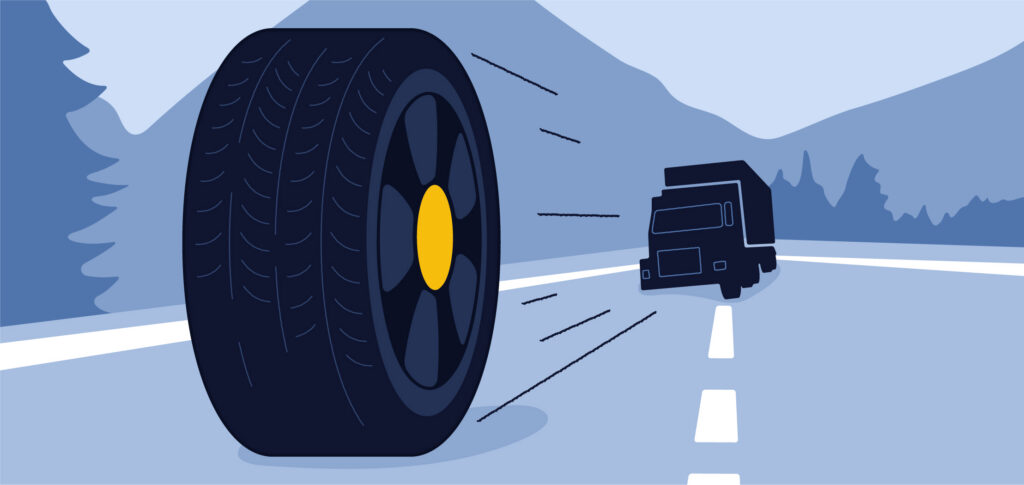
#1 Multiple Parties May Be Liable in a Texas Wheel-Off Crash
In a typical Texas car accident, liability usually points to one or two drivers. One driver followed too closely. Another driver made a bad turn. Someone ignored a traffic signal, drifted out of a lane, or drove too fast.
With wheel-off accidents, it’s usually a lot more complicated than that.
When a wheel separates from a vehicle, the real question is: Who put that vehicle on the road in that condition?
The vehicle owner may be responsible if they didn’t keep up with maintenance. A company might be at fault if it ignored problems, rushed inspections, or continued to use a vehicle that should’ve been parked. A repair shop could be to blame if it installed the wheel incorrectly, failed to torque the lug nuts, missed worn parts, or skipped basic steps.
A maintenance company may also carry blame if it was hired to inspect or repair the vehicle. If a defective part caused the wheel to detach, the manufacturer, distributor, or seller could become part of the claim, too.
This makes wheel-off accidents legally different from standard car crashes.
In a regular crash, the case often focuses on the seconds before impact. In a wheel-off case, the investigation may stretch back days, weeks, or months. A lawyer will need to find out who touched the vehicle, who inspected it, who signed off on repairs, who supplied the parts, and who gave the green light to put it back in service.
A wheel usually comes off for a reason. It could be poor maintenance, careless repair work, a weak part, or a company that prioritized speed and convenience over safety.
For this reason, you shouldn’t automatically trust the first explanation you hear.
The driver might not know the full story. The owner won’t be excited to admit that the vehicle had problems. A repair shop won’t be eager to own up to a mistake. A company may claim it had no warning, even when the records tell a very different story.
In Texas, fault can be shared between several different parties. That means a wheel-off claim can involve multiple insurance companies, defense attorneys, and plenty of finger-pointing.
Each side may try to dump blame onto someone else. That makes the case messy, but it can also show how many people had a hand in creating the danger.
For the injured person, the goal is clear: identify every person or company that played a role and hold them accountable under Texas law. That takes more than glancing at the police report. It takes a full investigation into the vehicle, its repair history, and the decisions that allowed it onto the road.
#2 Maintenance Records Are Key Evidence in Texas Wheel-Off Cases
Most Texas car accident claims rely on the basics. Photos. Police reports. Witness statements. Medical records. Maybe a dashcam video.
Those things still help in a wheel-off case, but they usually don’t answer the biggest question: why did the wheel come off?
That answer is often buried in the maintenance records.
A wheel-off accident usually points to a mechanical failure, a repair failure, or a missed warning sign. To figure out what happened, investigators need the vehicle’s history. When was the wheel last removed? Who worked on it? Were the lug nuts checked? Were the bearings inspected? Did anyone report vibration, wobbling, uneven tire wear, or strange noises before the crash?
Repair invoices reveal who performed the work. Inspection records can show whether the vehicle passed safety checks. Maintenance logs give insight into whether the owner had a real maintenance plan or only reacted after something broke down.
Sometimes, the records show a pattern that’s difficult to ignore.
A driver reported a problem, but no one fixed it. Several people complained about the same wheel area on a company vehicle. A shop worked on the exact wheel that later detached. A maintenance provider marked an inspection complete without doing a full check.
In a standard crash, that kind of paper trail might not carry much weight. In a Texas wheel-off accident, it can make or break the case.
Missing records can also say a lot.
If a company should have maintenance logs and can’t produce them, that raises questions. If repair orders are vague, incomplete, or suddenly hard to find, that deserves attention. If no one can explain who last worked on the wheel, that isn’t a small detail.
Timing can be especially important.
If a wheel comes off shortly after tire service, brake work, axle work, or bearing replacement, the recent repair history needs a hard look. Lug nuts could have been under-tightened, over-tightened, cross-threaded, or tightened unevenly. A technician might’ve skipped a torque check. The wrong parts may have been used. The job could’ve been rushed.
In many cases, the legal point is simple: someone had a chance to catch the problem before the accident happened.
#3 Federal and State Rules Apply to Texas Wheel-Off Accidents

Another major difference is the set of rules that can apply.
Most passenger car crashes are handled under basic Texas traffic laws and general negligence rules. A driver had a duty to drive safely, failed to do that, and caused harm. This is the usual setup.
Wheel-off accidents can bring in more rules, especially when a commercial vehicle is involved.
Commercial vehicles in Texas are subject to inspection and maintenance standards that don’t apply to ordinary passenger cars. Federal Motor Carrier Safety Administration rules require motor carriers to inspect, repair, and maintain vehicles according to strict standards.
Parts and accessories must be kept in safe working condition. Drivers also have inspection duties before and after trips in many commercial settings.
Texas has inspection rules for commercial vehicles as well. These rules exist to keep unsafe vehicles off the road.
So when a commercial vehicle loses a wheel, the question isn’t just whether the driver made a mistake. The bigger question is whether the company followed the rules.
Did they inspect the vehicle? Did they fix any known problems? Did they keep proper records? Did they let a truck operate when it should’ve been pulled from service?
Companies that run commercial vehicles can’t treat maintenance like an afterthought. A heavy wheel breaking loose at highway speed can cause major injury or death. The risk is obvious, and the law expects companies to take it seriously.
If a rule was violated, that violation can become strong evidence of negligence. It can show that the company failed to meet a safety standard already required by law. That doesn’t automatically decide the whole case, but it gives the injured person powerful proof.
These rules also determine which types of records should exist.
There should be driver vehicle inspection reports, annual inspection forms, repair orders, maintenance schedules, out-of-service records, and company safety policies in many commercial cases. Some companies also use electronic systems to track inspections and repairs.
A skilled attorney can use these records to build a timeline and test the company’s story.
This also differentiates wheel-off accident cases from ordinary car crash claims.
A private car owner usually won’t have formal inspection logs or written maintenance policies. A commercial operation typically will. Private crashes are rarely centered around complex insurance and contract issues. A commercial wheel-off case can involve several companies, contracts, and coverage layers.
In a Texas wheel-off accident, federal and state rules help lawyers show whether the crash was truly unexpected or whether someone did something very wrong.
When companies cut corners on vehicle safety, they shouldn’t get to shrug off responsibility after someone gets hurt.
#4 Technical Evidence Sets Texas Wheel-Off Cases Apart
A standard car crash often comes down to human behavior. Speed. Distraction. Lane changes. Braking. Reaction time.
Wheel-off accidents bring in a different type of proof.
These cases often require a deep analysis of wheel assemblies, lug nuts, studs, hubs, axles, bearings, tires, rims, and related parts. The crash scene doesn’t always reveal why the wheel detached.
Experts inspect the parts, review damage patterns, compare repair procedures, and explain whether the failure points to poor maintenance, bad installation, or a defective component.
It’s a very technical fight.
Electronic data can also help. Some vehicles record speed, braking, alerts, fault codes, and other useful information. Commercial vehicles can have GPS records, telematics data, driver logs, or maintenance software. Driver inspection reports can show whether warning signs were reported before the crash.
The goal is to tie the mechanical evidence to the facts of the legal claim.
Say a wheel comes off after recent tire work. The remaining lug studs can show stretching, stripping, or breakage that points to improper torque. The repair records can identify which shop worked on the wheel. Expert analysis can then explain how that repair mistake caused the wheel to separate.
Consider a situation where a bearing failed. There may be signs of long-term wear that should’ve been caught during inspection. If the maintenance logs show skipped service or repeated complaints, the case can point toward the owner or maintenance provider.
In cases where the work was done correctly, but the part itself failed, investigators may need to look at whether a product defect caused the detachment.
There’s no room for guessing in these cases. Guessing gives the defense room to attack the claim. A strong wheel-off case needs evidence that can hold up under pressure.
#5 Product Liability Claims Are Common in Texas Wheel-Off Cases

Some wheel-off accidents happen because someone didn’t properly maintain a vehicle. Others happen because a part failed.
When a defective part causes a wheel to separate, the claim can go beyond negligence and include product liability allegations. That adds a layer of legal complexity that standard Texas vehicle accident cases rarely have.
Product liability cases focus on whether a product was defective and whether that defect caused the injury. In a wheel-off case, the product could be a lug nut, wheel stud, hub, axle, bearing, tire, rim, or another part connected to the wheel assembly.
There are a few ways a product can be defective.
A manufacturing defect means something went wrong when the part was made. The design could be fine, but that specific part came out flawed.
A design defect means the product was made according to plan, but the plan itself created an unsafe product.
A warning or instruction defect means the product didn’t include proper directions or warnings for safe use. In a vehicle parts case, installation instructions, torque specifications, inspection warnings, or service guidance may be involved.
These claims are different from ordinary negligence claims. In a negligence case, the injured person usually argues that someone acted carelessly. A repair shop failed to tighten the lug nuts. A company skipped an inspection. A driver ignored a warning.
In a product liability case, the focus shifts to the part itself and the companies behind it.
Contact Grossman Law Offices After a Texas Wheel-Off Accident
If you or a loved one was hurt in a Texas wheel-off accident, the legal process can become overwhelming fast.
Grossman Law Offices has the experience to investigate every angle, from maintenance records to product defects, and fight to hold every responsible party accountable.
Reach out to our law firm today to talk through your Texas wheel-off accident case and find out how we can help you move forward.

 call us
  Email Us
  Text us