
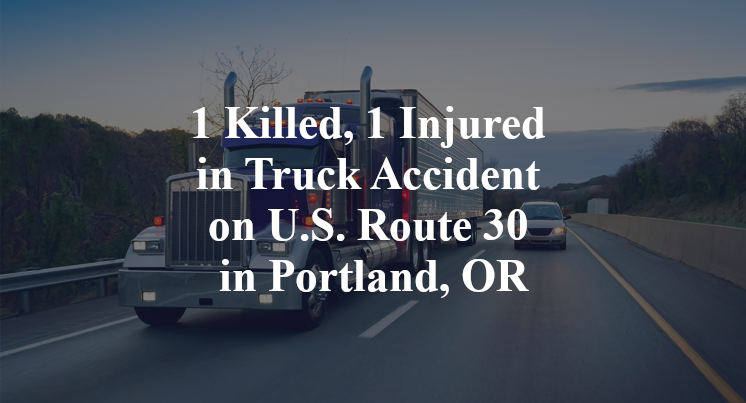
Portland, OR — June 9, 2025, one person was killed and another was injured in a truck accident at about 5:30 p.m. on U.S. Route 30/Northwest St. Helens Road.
Authorities said an SUV crashed into the back of a semi-truck that was slowing or stopped in traffic near the St. Johns Bridge.
Both people in the SUV were hospitalized with serious injuries after the crash, according to authorities. The driver died as a result of injuries sustained in the accident. Their names have not been made public yet.
Two dogs that were in the SUV with them were not injured, authorities said.
The truck driver, who remained at the scene of the accident, is cooperating with authorities.
Authorities have not released any additional information about the crash at this time. The accident is still under investigation.
Commentary by Attorney Michael Grossman
When people read that an SUV crashed into the back of a semi-truck, the natural reaction is to assume the SUV driver was at fault. After all, rear-end collisions typically carry that presumption. But in a case like this, where the truck was reportedly “slowing or stopped in traffic,” that basic assumption may not hold up.
The first thing I want to know is: Was the truck already stopped when the SUV came up behind it? If so, how long had it been stopped? And most importantly, was it visible? These are all open questions.
Depending on whether the truck was moving or stopped, different questions arise. If it had just slowed abruptly, then we’d want to know if the driver braked suddenly without giving enough warning. On the other hand, if the truck was stopped for some time, visibility becomes a critical issue, especially if it was in a shaded or curved area of the road near the St. Johns Bridge. Was the trailer lit or marked adequately? Did the SUV driver have enough time and distance to see and react?
Another question worth asking: Was the truck where it was supposed to be? In some crashes I’ve worked on, trucks were improperly stopped in travel lanes due to mechanical issues or driver error. When that happens, the presence of a massive, barely-visible obstacle can turn into a deadly trap for approaching drivers.
Determining fault in this kind of crash isn’t about guesswork; it’s about evidence. Investigators need to examine dash cam footage, ECM data and the SUV’s data recorder if it has one. Was the SUV speeding or distracted? Was the truck improperly positioned, or not using hazard lights?
And we can’t overlook the role of the trucking company. Was the truck properly maintained? Did the driver follow company policy when slowing or stopping in traffic? Did the company train its drivers on how to avoid becoming a hazard in low-visibility areas?
I’ve handled cases where a crash seemed simple on paper, but once we dug into the evidence, it became clear that a trucking company’s poor decisions — whether in driver supervision or equipment upkeep — were the real cause.
Right now, authorities haven’t released much information. That’s common in the early days of a crash investigation. But that lack of detail shouldn’t lead anyone to leap to conclusions. It’s easy to assume the SUV driver made a mistake, but without the data, that’s just speculation.
The goal of any serious investigation is to get the full picture: who did what, when and why. That’s the only way to figure out who, if anyone, should be held accountable.
Key Takeaways
- It’s not yet clear whether the truck was moving or stopped at the time of the crash; each scenario raises different legal questions.
- Visibility, vehicle positioning and lighting all factor into who may be at fault in a rear-end collision with a semi-truck.
- Critical evidence includes ECM data, dash cams and visibility assessments at the crash site.
- Trucking company policies and maintenance records may also play a role in determining liability.
- Real accountability depends on evidence, not assumptions, and that process is still underway.

 call us
  Email Us
  Text us