
Newburg, MD — July 15, 2025, one person was killed due to a truck accident just before 2:45 p.m. along Crain Highway (U.S. 301).
According to authorities, the accident took place where Crain Highway and Rock Point Road intersect.
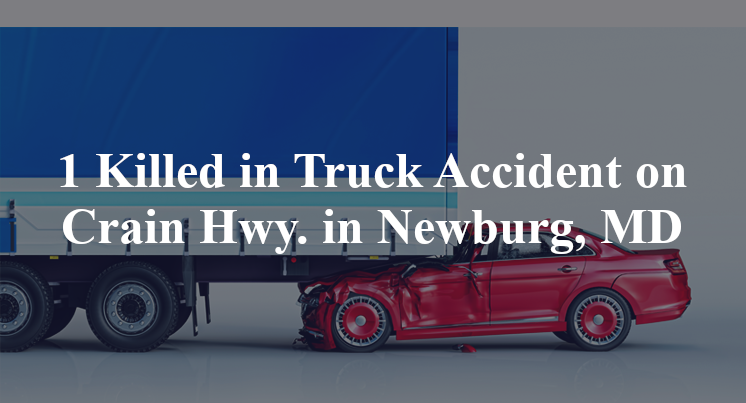
Details surrounding the accident remains scarce. Officials indicate that, for as yet unknown reasons, a vehicle collided with the trailer of an 18-wheeler, becoming entrapped beneath. The person who had been behind the wheel had to be extracted by emergency personnel. They had reportedly sustained fatal injuries due to the wreck and were declared deceased at the scene. Additional information pertaining to this incident—including the identity of the victim—is not available at this point in time. The investigation is currently ongoing.
Commentary by Attorney Michael Grossman
When a vehicle ends up wedged beneath the trailer of an 18-wheeler, the question isn’t just how the crash happened—it’s why the trailer was positioned in a way that allowed a car to go underneath it in the first place. These types of collisions, often referred to as underride crashes, are almost always deadly, and they tend to raise serious questions about truck maneuvering, visibility, and timing.
The fact that the vehicle struck the trailer—not the front or rear of the truck—strongly suggests that the 18-wheeler may have been turning, backing, or crossing the intersection at the time of impact. That makes the truck’s position and motion a key part of the investigation. Was the trailer already blocking a travel lane? Was the truck driver executing a slow turn across opposing traffic? Did they have a protected green light, or were they relying on a judgment call in an unprotected intersection?
I’ve handled multiple cases involving this kind of trailer-side impact, and one recurring theme is poor visibility. In many cases, the side of a trailer—especially an unlit one crossing perpendicular to a driver’s path—can be all but invisible until it’s too late. If the trailer was not equipped with reflective markings or if lighting conditions made it difficult to see, investigators will need to ask whether the trailer was reasonably visible at all. That’s especially important near intersections like Crain Highway and Rock Point Road, where complex traffic patterns and turn lanes can make judging movement more difficult.
There’s also the matter of timing: If the truck entered the intersection at a slow pace and began blocking a lane of travel without allowing enough time for through traffic to clear, that decision could be a contributing factor—even if the car had the right of way. Truck drivers are trained to avoid partial crossings for exactly this reason.
Key Takeaways
- A key question is whether the 18-wheeler was crossing or turning across a lane of traffic when the vehicle struck the side of the trailer.
- Side underride crashes often involve poor trailer visibility, particularly if reflectors or lights are inadequate or obstructed.
- Investigators should examine trailer position, lighting, and the timing of the truck’s movement through the intersection.
- If the truck partially blocked a travel lane without ensuring it could clear the intersection, that could be a critical failure.
- Understanding fault will depend on reconstructing who entered the intersection when—and whether either party had a fair chance to avoid impact.

 call us
  Email Us
  Text us