
Jasper County, IN — August 4, 2025, one person was killed in a truck accident at about 11 p.m. on southbound Interstate 65 near Fair Oaks.
Authorities said a bobtail truck stopped in traffic near mile marker 218. Another semi-truck swerved into the median, hitting the cable barrier, as it tried to avoid a collision, only for a third semi-truck to hit the first one. Those two trucks caught fire after the crash.
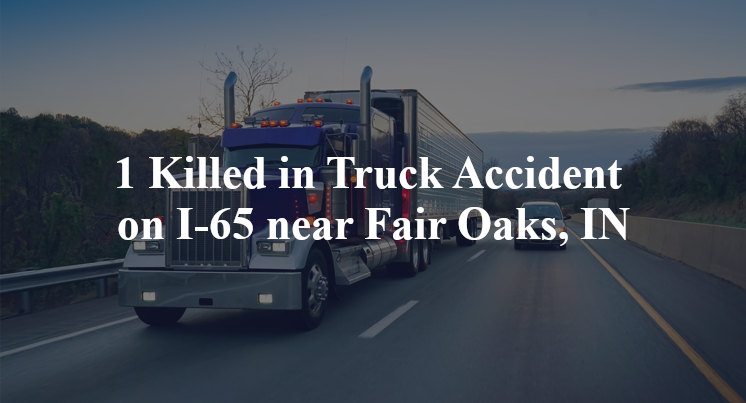
The driver of the third truck, whose name has not been made public yet, died in the crash, according to authorities. The truck had been hauling peat moss, which proved hard for firefighters to extinguish.
Authorities have not released any additional information about the Jasper County crash at this time. The accident is still under investigation.
Commentary by Attorney Michael Grossman
When people hear that three 18-wheelers were involved in a fiery crash that left one driver dead, the immediate question is: How does something like this happen? And just as important: Are we getting the full story?
From the details currently available, we know that a bobtail truck, meaning it wasn’t hauling a trailer, was stopped in traffic on I-65 late at night. A second truck swerved into the median to avoid hitting it. A third truck, hauling peat moss, wasn’t able to stop in time and collided with the first. That’s the one that caught fire and left its driver dead.
But even that chain of events leaves a lot unsaid.
We don’t yet know why the bobtail was stopped in the first place. Was there a prior incident? Was the truck disabled? Or was the driver simply stopped for reasons unknown? Depending on the answer, different questions arise. If it broke down, that might be no one’s fault. But if it was stopped improperly or without lights or warning signals, that could put responsibility squarely on the bobtail driver, or even the company that maintains the truck.
The same goes for the third truck. Was the driver distracted? Asleep? Driving too fast to stop in time? Those questions can’t be answered by guesswork. They require evidence. Engine control module (ECM) data can show when the brakes were applied and how fast the truck was going. Cell phone records can reveal if the driver was texting or on a call. In-cab cameras, if the truck had them, can show whether the driver was paying attention.
Then there’s the load. Peat moss isn’t exactly explosive, but it’s highly flammable. That raises another question: Was the cargo secured and stored properly? In a case I handled, a fire broke out after a crash because the cargo wasn’t stowed in accordance with hazmat protocols, even though it wasn’t classified as dangerous on paper. It’s too early to say whether that’s true here, but it’s something investigators will need to look at carefully.
One final note: three trucks, late at night, stopped traffic, evasive maneuvers, and a deadly impact; those ingredients are rarely the result of a single bad decision. More often, it’s a series of oversights: maybe someone didn’t maintain a vehicle properly, another failed to train a driver, another still didn’t give drivers enough time to rest. I’ve seen cases where the most negligent party never even touched a steering wheel. That’s why investigations need to go deeper than just the crash scene. They need to follow the evidence wherever it leads: whether that’s to the driver’s cab, the dispatcher’s desk or the corporate office that sets unrealistic schedules.
Key Takeaways:
- It’s not clear why the bobtail truck was stopped in traffic, which is central to understanding who may be responsible.
- Critical evidence — ECM data, cell phone records and dash cam footage — will be key to determining whether the third truck’s driver could have avoided the crash.
- The cargo’s flammability raises questions about how it was loaded and whether it contributed to the fatal outcome.
- Multiple parties may share responsibility, including those who hired, trained or scheduled the drivers involved.
- A full investigation should look beyond the crash site to uncover any systemic failures that led to the wreck.

 call us
  Email Us
  Text us