
Berkeley, IL — July 23, 2025, one person was killed in a truck accident at about 4 a.m. on eastbound Interstate 294.
Authorities said a semi-truck hauling cheese overturned on the ramp to southbound Interstate 290 after the driver apparently lost control. The truck started leaking fuel after the crash.
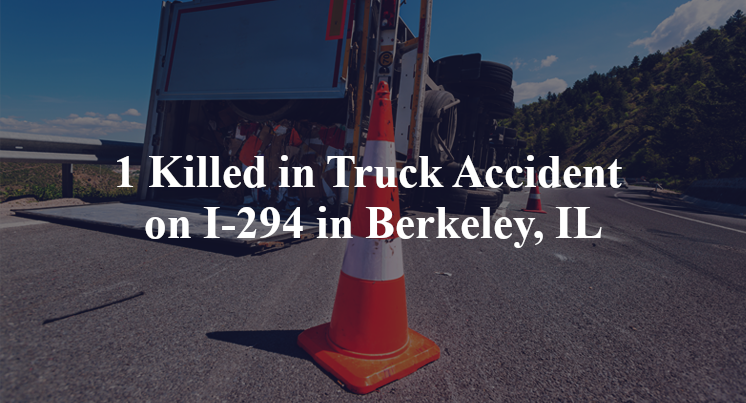
The driver, whose name has not been made public yet, died at the scene of the crash, according to authorities.
Authorities have not released any additional information about the Cook County crash at this time. The accident is still under investigation.
Commentary by Attorney Michael Grossman
When people hear about a truck overturning on a highway ramp, the first question they often ask is, “How does something like that even happen?” And it’s a fair question. Tractor-trailers don’t just flip over without something going seriously wrong, whether that’s with the driver, the equipment, the load or the conditions on the road.
At this point, it’s not clear whether the truck was speeding, improperly loaded or whether something else caused the driver to lose control. We also don’t know whether another vehicle might have played a role, or if mechanical failure contributed to the crash. Until those questions are answered, it’s premature to place blame, especially when the only person who might have firsthand knowledge is no longer alive to explain what happened.
That’s why any proper investigation into a crash like this has to go far beyond the scene. First, it’s important to look at the truck’s engine control module (ECM), essentially the vehicle’s black box, to understand what it was doing in the moments before the crash. Was it braking? Accelerating? Taking a curve too fast? Second, if the truck had dash cams or in-cab video (as many now do), those could provide critical context about the driver’s actions or anything unexpected on the roadway.
Another angle investigators can’t afford to overlook is the truck’s cargo and how it was secured. Cheese may not seem like hazardous material, but depending on how it was packed and stacked, it could dramatically affect the truck’s center of gravity. A top-heavy load or one that shifts in a curve can easily cause a rollover. That raises questions about who loaded the truck, what procedures they followed and whether those procedures were safe and industry-standard.
The company that owns the truck also deserves scrutiny. What do we know about their hiring and training policies? Was the driver new to the job or route? Had they been driving too many hours without rest? These are all common factors in rollover crashes I’ve handled in the past. In one case, a company put a driver behind the wheel who had already been let go from several prior jobs and barely screened him before sending him out on the road. That’s not just bad luck; that’s corporate negligence.
None of these questions can be answered with a press release. They require access to hard data, documents and internal policies; evidence that’s often only uncovered through litigation.
Key Takeaways:
- It’s unclear what caused the driver to lose control; several possibilities must be investigated, including speed, loading practices and road conditions.
- Black box data, dash cams and cell phone records can provide vital insight into the crash sequence.
- Improper loading could have played a role if the cargo made the truck unstable or prone to rollover.
- The trucking company’s hiring, training and safety practices are central to understanding potential systemic issues.
- Real accountability depends on gathering and analyzing all available evidence, not on early assumptions.

 call us
  Email Us
  Text us