
Baton Rouge, LA — July 22, 2025, three people were injured due to a truck accident at approximately 4:45 a.m. along Interstate Highway 10.
According to authorities, the accident took place on I.H. 10 in the vicinity of Perkins Road.
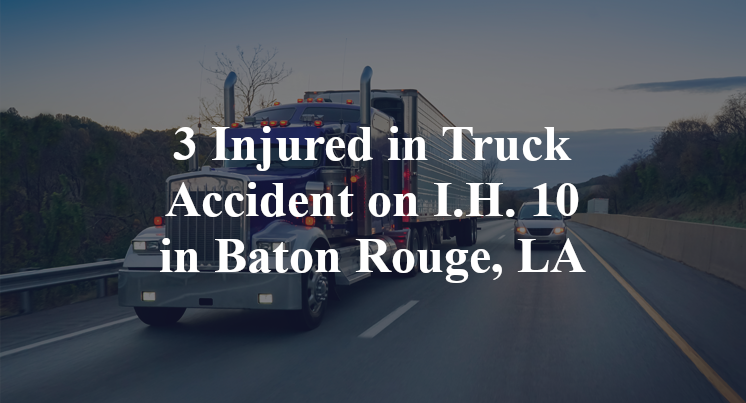
Officials indicate that, for as yet unknown reasons, a collision took place between an 18-wheeler and a passenger vehicle. Three people reportedly sustained injuries of unknown severity; they were each transported to local medical facilities by EMS in order to receive necessary treatment. Additional details pertaining to this incident—including the identities of the victims—are not available at this point in time.
Commentary by Attorney Michael Grossman
When a crash involving an 18-wheeler and a passenger vehicle sends three people to the hospital, the first priority has to be understanding how the two vehicles came into contact—especially in the early morning hours when traffic is typically light. Did the truck drift into another lane? Did the passenger vehicle make an unsafe maneuver? Or did poor visibility or road conditions contribute to a breakdown in communication between the vehicles?
With so few details available, it’s hard to draw conclusions—but that doesn’t mean investigators are starting from scratch. One of the most effective tools in cases like this is the truck’s engine control module (ECM), which can reveal whether the truck was braking, accelerating, or steering sharply in the moments before the crash. If dash cam footage or in-cab video exists, it can help fill in the rest of the picture—including whether the driver was alert and tracking the road properly.
Another important factor is lighting and visibility. At 4:45 a.m., it’s still dark, and many crashes at that hour involve vehicles that didn’t see each other in time. Headlight function, trailer reflectivity, and even lane markings can become critical in explaining why a driver didn’t react sooner—or at all. In some cases, passenger vehicles fail to appreciate just how long it takes a fully loaded truck to slow down or maneuver, especially if they cut in too closely or change lanes abruptly.
Crashes like this also raise the question of driver readiness. Was the truck driver nearing the end of a long shift? Had they recently come on duty and were still warming up mentally? It’s a scenario worth exploring, because early-morning crashes often coincide with periods of low alertness, especially for drivers who’ve been on the road overnight.
Ultimately, this is a situation where responsibility could lie with either driver—or both. The key is to secure the right evidence quickly, because without ECM data, vehicle inspections, and scene documentation, it’s easy for the real story to be lost in speculation.
Key Takeaways:
- The cause of the early-morning crash involving an 18-wheeler and a passenger vehicle remains unclear.
- ECM data and dash cam footage could be critical in understanding each vehicle’s actions before the collision.
- Lighting, visibility, and reflective markings should be evaluated, given the time of day.
- Driver fatigue or low alertness may be a factor and should be investigated through logs and schedules.
- Responsibility may lie with either or both drivers, and a thorough investigation is the only way to know for sure.

 call us
  Email Us
  Text us