

Lee County, AL — August 13, 2025, one man was killed due to a single-vehicle truck accident at approximately 5:30 p.m. along Interstate Highway 85.
According to authorities, the accident took place on I.H. 85 in the vicinity southwest of Bent Creed Road.
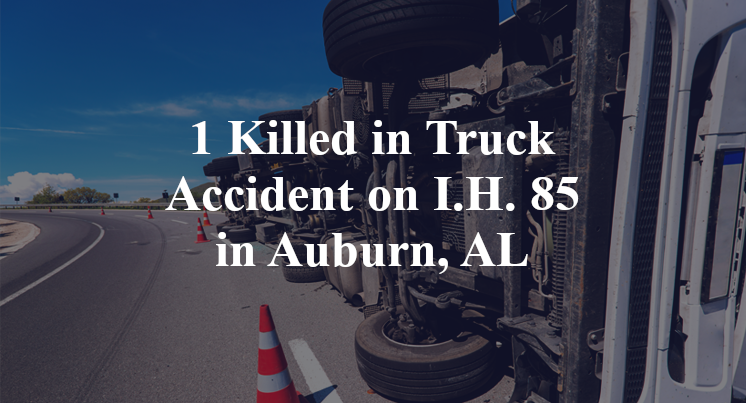
Details surrounding the accident remain scarce. Preliminary reports state that, for as yet unknown reasons, an 18-wheeler was involved in a single-vehicle collision in which it left the roadway and crashing into a wooded area, apparently coming to a stop between 40 and 50 yards from the road.
The man—reportedly from California—was entrapped in the wreckage and had to be extricated by emergency personnel. However, it appears the injuries he sustained over the course of the accident were fatal. Additional details pertaining to this incident—including the identity of the victim—are not available at this point in time. The investigation is currently ongoing.
Commentary by Attorney Michael Grossman
When a commercial truck ends up wrecked in the woods with no other vehicles involved, the first question that comes to mind is: How does something like that even happen? Unfortunately, the early reports about this crash offer little more than a conclusion without any explanation. And that’s a problem—because until we know why the truck went off the road, we can’t begin to understand who, if anyone, should be held accountable.
It’s easy to assume the driver made a mistake. Maybe he fell asleep or was distracted. That’s certainly possible—but making assumptions without evidence risks overlooking other factors that could have played a role. Was the driver fighting to stay awake because his employer pushed him to drive too many hours? Was there a mechanical failure? Did he lose control while trying to avoid something on the road? These are all unanswered questions, and each one points to a different kind of liability.
To get real answers, investigators need to move quickly to secure electronic evidence. That includes the truck’s engine control module (ECM), which can show speed, braking, and steering data in the moments before the crash. If the truck had in-cab video, it might confirm whether the driver was alert or dealing with some emergency. Phone records may indicate whether he was using a device at the time. Without that information, it’s nearly impossible to draw meaningful conclusions.
Beyond what happened in the cab, there’s also the question of who put this driver on the road in the first place. Was he properly screened before being hired? Was he trained to handle emergency situations? In a case I handled not long ago, the trucking company gave a driver a 20-minute road test and called it a full evaluation—despite the fact that she’d already been fired from multiple previous jobs. When she later caused a crash, it was clear that the company’s poor hiring practices played a far bigger role than anything she did behind the wheel.
That’s why it’s so important not to stop at surface-level explanations. Single-vehicle truck crashes may look simple on paper, but in my experience, the truth is rarely that neat. The real story usually comes out only after someone takes the time to dig into the data, examine the policies behind the scenes, and ask hard questions that the initial reports leave unanswered.
Key Takeaways
- It’s too early to assume why the truck went off the road; key evidence has yet to be disclosed.
- Electronic data like ECM downloads, in-cab video, and phone records are essential to understanding what happened.
- Driver error is one possibility—but company policies, training, and hiring decisions could also be factors.
- Surface-level reports often miss deeper issues that only a thorough investigation can uncover.
- Accountability requires facts, not assumptions—and those facts must be secured before they disappear.
 call us
  Email Us
  Text us