
Allen Park, MI — June 6, 2025, one person was killed in a truck accident at about 12:25 a.m. on westbound Interstate 94/Detroit Industrial Expressway.
Authorities said a pickup crashed into a gravel hauler that had been broken down on the shoulder near State Highway 39.
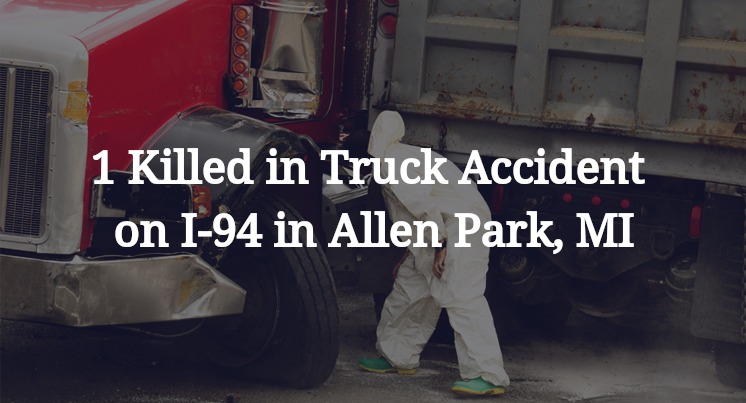
The driver of the pickup, a 64-year-old Dearborn Heights man, died at the scene of the crash, according to authorities. His name has not been made public yet.
No other injuries were reported.
Authorities have not released any additional information about the Wayne County crash at this time. The accident is still being investigated.
Commentary by Attorney Michael Grossman
When people hear that a pickup hit a broken-down gravel hauler on the shoulder of I-94, they might assume it’s a simple case of driver inattention. But that assumption skips over several key questions that an experienced truck accident investigation would ask right away: Why was the gravel hauler stopped there? Was it entirely on the shoulder? Was it properly marked and lit? Could the pickup driver have avoided it? Without those answers, we can’t begin to understand who may be responsible.
At this point, authorities have said only that the truck had broken down and was on the shoulder. That leaves a lot unsaid. For example:
- Was the truck fully off the road? Sometimes large trucks are so wide or poorly positioned that part of them extends into an active lane. If that happened here, then the stopped truck may not have been as safely “out of the way” as the phrase “on the shoulder” suggests.
- Were its hazard lights, reflectors or warning triangles properly deployed? Federal regulations require specific warning devices to be placed behind a stopped truck to alert approaching drivers. If the truck driver didn’t follow those rules, it’s possible the pickup driver had no real chance to see the hazard in time.
- What visibility conditions were like at 12:25 a.m.? A dark, poorly lit stretch of highway with a disabled, unlit truck could be a deadly trap even for a reasonably careful driver.
- What does the black box data show? The gravel hauler’s engine control module (ECM) may provide insights about when and how the truck lost power, how long it had been stopped and whether the driver took the proper steps to secure the vehicle.
In my experience, holding the right people accountable in these cases depends entirely on evidence: dashcam footage, ECM downloads, cell phone records and sometimes even roadside camera feeds. It’s not enough to know that a truck was stopped and someone died. We have to know why the truck was stopped, how it was stopped and what steps the driver and company took once it was clear there was a problem.
It’s also worth investigating the gravel hauler’s maintenance history. Was this a mechanical failure that could have been prevented? Did the company delay needed repairs or fail to inspect the vehicle properly before sending it out on the road? In one of my previous cases, a trucking company skipped routine brake maintenance, which eventually led to a fatal crash. That sort of negligence only comes to light when someone goes beyond the surface facts.
Key Takeaways
- It’s not yet clear if the gravel hauler was fully off the road, properly marked or safely positioned.
- Federal regulations require warning devices when a truck is disabled; whether those were used remains unanswered.
- Black box data and roadside evidence will be critical to understanding what really happened.
- Trucking company maintenance and response protocols could also factor into liability.
- As always, real accountability only comes when all the facts are brought to light through a detailed investigation.

 call us
  Email Us
  Text us