
Northwood Park, TX — December 15, 2024, a man was injured following a motorcycle versus car accident just before 11:00 p.m. along Farm to Market 2920.
According to authorities, a 40-year-old man from Tomball was traveling on an eastbound Victory Motorcycles High-ball motorcycle on F.M. 2920 at the Falvel Road intersection when the accident took place.
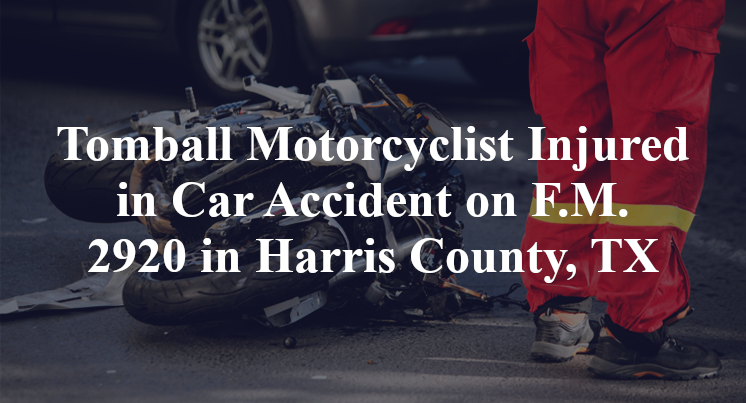
The cause of the accident remains unclear. Officials indicate that, for as yet unknown reasons, a westbound Nissan Sentra on F.M. 2920 attempted a left turn onto Falvel Road at an apparently unsafe time, failing to yield the right-of-way to oncoming traffic. This resulted in a collision between the motorcycle and the Sentra.
The motorcyclist reportedly suffered serious injuries over the course of the accident. It does not appear that anyone else was hurt. Additional details pertaining to this incident—including the identity of the victim—are not available at this point in time. The investigation is currently ongoing.
Commentary by Attorney Michael Grossman
When a left-turning vehicle collides with an oncoming motorcycle, particularly at a signalized or marked intersection like Farm to Market 2920 and Falvel Road, it’s common to assume that the turning driver simply misjudged the distance or speed of the motorcycle. But that assumption can overlook key factors that influence how these crashes unfold. To understand what really happened—and to ensure the injured motorcyclist isn’t left without answers—there are three important questions that should be asked.
First, did the authorities conduct a thorough investigation? Motorcycle crashes, especially those involving left turns across oncoming traffic, require detailed analysis of timing, vehicle positioning, sightlines, and lighting conditions. Did the turning driver have a clear and unobstructed view of the motorcyclist? Were there any obstructions that limited reaction time? Did investigators document the position of each vehicle and obtain statements from witnesses? In many cases, especially late at night, these critical details may be incomplete unless an independent investigator is brought in to conduct a more comprehensive review.
Second, has anyone considered whether a mechanical issue contributed to the crash? It’s easy to frame these incidents purely in terms of decision-making, but mechanical failures—such as brake issues, steering problems, or lighting malfunctions—can also play a significant role. Was the motorcycle’s headlight functioning properly? Did the turning vehicle behave as expected, or did a defect in the braking or steering system contribute to the failure to yield? These are questions that can only be answered through a forensic inspection of the vehicles, and only if those vehicles are preserved after the crash.
Lastly, has all electronic data from the vehicles been collected? While most motorcycles don’t carry event data recorders, some newer models or aftermarket systems may capture speed or GPS data. The Nissan Sentra likely contains a black box capable of recording vehicle speed, throttle input, and braking activity in the seconds before the crash. That data can help confirm whether the driver slowed, hesitated, or accelerated into the turn. Additionally, phone records, traffic camera footage, or surveillance video from nearby businesses could help clarify how the crash unfolded. But all of this data is time-sensitive and must be retrieved quickly.
In a crash where a motorcyclist is seriously injured and the full circumstances remain unclear, surface-level explanations aren’t enough. Asking these questions is the least that can be done to ensure that those affected by this crash get the clarity and closure they deserve.

 call us
  Email Us
  Text us