
Clark County, OH — September 4, 2025, Saida Usmonova and Harminder Singh were injured in a truck accident at about 5 p.m. on Interstate 70/Dwight D. Eisenhower Freeway.
Authorities said a 2025 Freightliner Cascadia semi-truck was parked on the right shoulder of westbound I-70 near Enon when it was struck from behind by a 2005 Volvo VNL semi-truck hauling motor oil. The collision caused an explosion and spilled oil onto the highway.
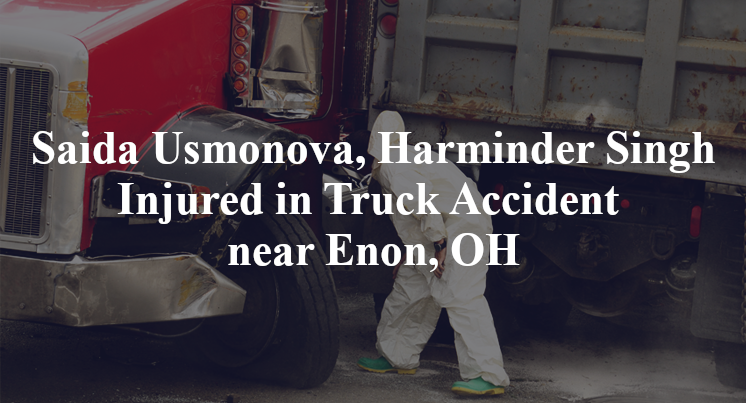
Both drivers, California resident Saida Usmonova from the Freightliner and Washington resident Harminder Singh from the Volvo, were hospitalized with serious injuries after the crash, according to authorities.
Authorities have not released any additional information about the Clark County crash at this time. The accident is still under investigation.
Commentary by Attorney Michael Grossman
When people hear that one semi-truck crashed into another parked on the shoulder, they’re often left wondering: How does something like that even happen? Was the parked truck legally stopped? Was the moving truck driver distracted or fatigued? And more importantly, who’s ultimately responsible?
From the limited information available, it appears that a 2025 Freightliner was parked on the shoulder of I-70 when a 2005 Volvo semi hauling motor oil slammed into it, causing an explosion and oil spill. Both drivers were seriously injured. That raises some immediate questions that the initial reports don’t answer.
One of the first things that needs to be verified is whether the Freightliner was stopped legally and safely. There’s a world of difference between a truck that’s pulled over due to an emergency and one that’s parked improperly to take a break, check directions or handle paperwork. If the truck was disabled, did the driver activate hazard lights? Deploy warning triangles? The law has clear rules for how commercial vehicles must signal their presence when stopped on the shoulder, especially on high-speed highways.
On the other side, we also need to know what the Volvo driver was doing in the moments leading up to the collision. Was the driver distracted? Drowsy? Was there any mechanical failure? These are not just hypothetical questions. They’re the kinds of issues that black box data, dash cam footage and phone records can help clarify.
In my experience, I’ve handled cases where what seemed like a simple rear-end collision turned out to be much more complicated. One involved a driver who rear-ended a stopped truck because he was looking down at his GPS. Another turned out to involve a parked truck that hadn’t placed any reflective triangles, making it invisible at dusk. In both cases, the answer didn’t lie in assumptions. It lay in the evidence.
The fact that the Volvo was hauling motor oil adds another layer of complexity. Oil is a hazardous material. That means both loading and containment procedures are critical. If any part of that load was improperly secured or the tank was structurally unsound, the risk of explosion increases. Depending on how the oil was stored — tanker trailer, drums or intermediate bulk containers (IBCs) — the rules and responsibilities change. We don’t yet know what type of containment system was used, so that’s one more unanswered question.
When investigators look into a crash like this, they can’t just stop at the drivers. They also have to look at company policies, training practices, vehicle maintenance records and cargo handling procedures. I’ve litigated cases where the driver never should’ve been hired in the first place or where a carrier ignored glaring safety issues for months. Holding the right parties accountable means asking all of these questions, and getting verifiable answers.
Key Takeaways:
- It’s not yet clear whether the parked truck was stopped legally or if it had proper warning signals in place.
- Investigators will need to review black box data, phone records and dash cam footage to understand what the moving truck driver was doing.
- The presence of hazardous cargo (motor oil) raises questions about containment procedures and whether those increased the explosion risk.
- Full accountability depends on more than just driver behavior. It includes company practices and mechanical integrity.
- Determining fault will require a thorough, evidence-based investigation, Assumptions aren’t enough.

 call us
  Email Us
  Text us