
Brown County, IL — June 28, 2025, Rusty Rickard was killed due to a motorcycle versus truck accident that took place along 1400 East Street.
According to authorities, Rusty Rickard, of Ripley, Illinois, was traveling on a northbound motorcycle on North St. Marie Road at the County Road 950 North intersection when the accident took place.
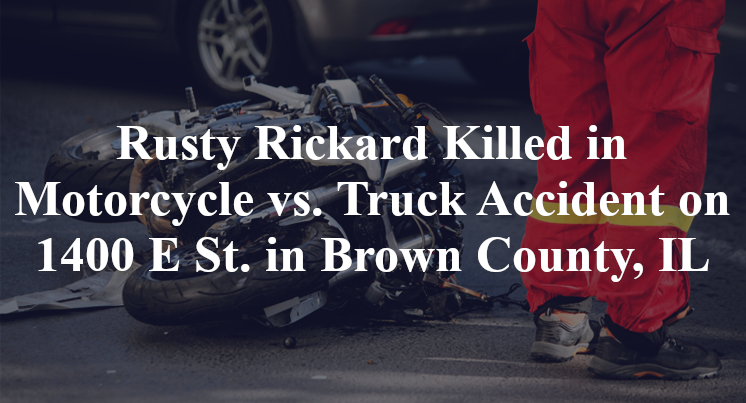
Officials indicate that, for as yet unknown reasons, a truck that had been traveling westbound entered the intersection at an apparently unsafe time, failing to yield the right-of-way. A collision consequently took place between the motorcycle and the truck. Rickard reportedly sustained fatal injuries as a result of the wreck. Additional details pertaining to this incident are not available at this point in time. The investigation is currently ongoing.
Commentary by Attorney Michael Grossman
When a truck enters an intersection and a motorcyclist doesn’t make it through alive, the question that immediately follows is: Why didn’t the truck yield? From what’s been reported so far, that’s the action that set this fatal crash in motion. And when a vehicle as large as a truck misjudges an oncoming motorcycle, the consequences are often irreversible.
Motorcycles are harder to see than full-size vehicles, but that doesn’t relieve a driver of their responsibility to confirm the path is clear before pulling into an intersection. In cases I’ve handled where a truck failed to yield, we’ve often found the problem wasn’t visibility—it was speed, inattention, or the false assumption that the motorcycle was farther away than it actually was. Either way, that’s not a visual issue. It’s a decision-making failure.
The location of the crash—at a rural intersection—only adds to the risk. Intersections like the one at North St. Marie and County Road 950 often lack traffic signals, and sightlines may be blocked by trees, uneven ground, or even farming equipment. If the truck driver didn’t come to a complete stop, or if they simply failed to look long enough to detect a smaller approaching vehicle, that’s a critical lapse. Investigators will need to determine what the view was like, whether the road markings were clear, and how fast each vehicle was traveling.
Speed data from the motorcycle, if retrievable, will also be important. Not because the rider is suspected of wrongdoing, but because it will help confirm how long the truck driver had to perceive and respond to the oncoming vehicle. Many motorcycles don’t have onboard data systems, but physical evidence—like skid marks, debris spread, and impact points—can still offer a reliable timeline.
I’ve seen rural intersection crashes where the trucking company tried to blame the motorcyclist for “coming out of nowhere,” only for the evidence to show they had several seconds of visibility and simply chose to pull out anyway. Whether that kind of error was at play here remains to be seen—but it’s a question that must be answered before responsibility can be properly assigned.
Key Takeaways
- The reported failure to yield by the truck driver is the key act that set the collision in motion, but the circumstances behind that decision must be investigated.
- Rural intersections often present limited sightlines and lack traffic signals, increasing the need for driver caution.
- Investigators should examine whether the truck stopped fully, how visible the motorcycle was, and whether speed or distraction played a role.
- Physical evidence from the scene—skid marks, impact location, and vehicle positions—will be crucial to reconstructing the crash.
- Understanding what went wrong here means looking beyond who had the right-of-way and into why the truck driver moved when they did.

 call us
  Email Us
  Text us