
Riverside County, CA — July 10, 2025, at least one person was killed due to an overturned truck accident shortly before 7:00 a.m. along Interstate Highway 10.
According to authorities, the accident took place in the eastbound lanes of I.H. 10 in the vicinity of Date Palm Drive.
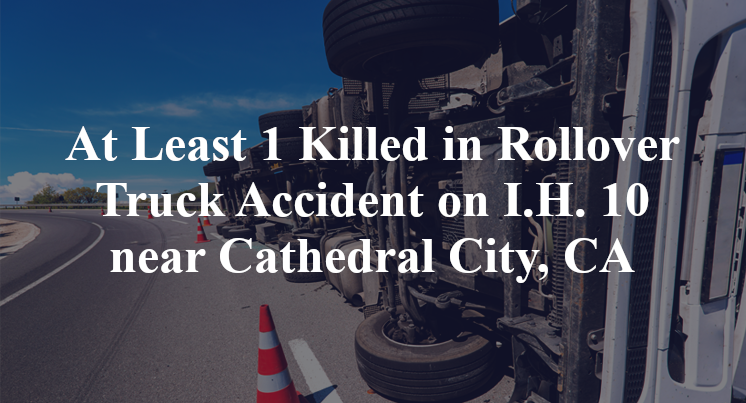
Details surrounding the accident remain scarce. Officials indicate that, for as yet unknown reasons, a multi-vehicle accident took place in which an 18-wheeler apparently overturned. Reports state that as many as two people may have lost their lives as a result of the wreck. The number of additional injured victims, if any, has not been stated in reports. Additional information pertaining to this incident—including the identity(s) of the victim(s)—is not available at this point in time. The investigation is currently ongoing.
Commentary by Attorney Michael Grossman
When an 18-wheeler overturns on a major interstate and people lose their lives, the critical question isn’t just what made the truck roll—it’s what led up to that moment, and could it have been avoided? Truck rollovers are rarely caused by a single factor. More often, they’re the end result of a chain of decisions, conditions, or mechanical issues that set the crash in motion long before the truck tipped over.
At this point, we don’t know exactly how the truck came to overturn. Was it navigating a curve? Was it braking suddenly in traffic? Did it swerve to avoid another vehicle? Any of those scenarios is possible in a multi-vehicle crash, especially during early morning hours when traffic patterns are unpredictable and visibility may be changing.
One likely focus of the investigation will be load stability. If the 18-wheeler’s cargo wasn’t properly secured or was loaded unevenly, that could have raised the center of gravity and increased the risk of rollover during sudden maneuvers. In cases I’ve handled, improperly balanced loads caused trailers to tip even when the driver was following the speed limit and reacting appropriately to traffic conditions. That’s why load documentation and trailer inspection are critical.
Another factor is braking and steering input. Black box data can show whether the truck was braking sharply, turning aggressively, or accelerating—all of which matter when evaluating whether the rollover was a result of driver response or equipment limitations. If the driver made a hard correction to avoid a hazard, investigators will need to determine whether that hazard was avoidable or created by another driver’s actions.
Finally, investigators should consider the road layout near Date Palm Drive. Was the truck exiting or merging? Were there elevation changes or lane shifts that may have influenced how the truck handled in the seconds before the crash? Rollover risk increases dramatically when tight curves, uneven surfaces, or construction zones are involved.
Key Takeaways
- The key issue is what led the 18-wheeler to overturn—whether due to load instability, driver maneuvering, or outside factors in traffic.
- Black box data will help clarify the truck’s speed, braking, and steering behavior leading up to the rollover.
- Cargo records and trailer inspection are necessary to evaluate whether the load contributed to the loss of stability.
- Road layout and traffic conditions should be examined to determine whether environmental factors played a role.
- A full reconstruction is required to understand whether this fatal rollover was the result of driver error, equipment failure, or a chain reaction caused by other vehicles.

 call us
  Email Us
  Text us