
Cooke County, TX — March 20, 2025, Reed Spence was injured following a motorcycle versus truck accident shortly after 9:00 a.m. along U.S. Highway 82.
According to authorities, 22-year-old Reed Spence was traveling on a westbound Yamaha motorcycle on J M Lindsay Boulevard (U.S. 82) approaching the F.M. 1201 intersection when the accident took place.
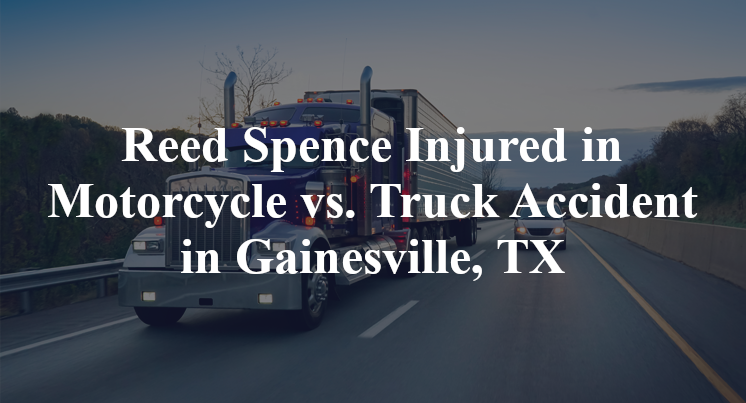
Officials indicate that, for as yet unknown reasons, a Kenworth truck that had been traveling southbound on F.M. 1201 attempted to enter the highway at an apparently unsafe time, failing to yield the right-of-way at a stop sign. This resulted in a collision between the Kenworth and the motorcycle. Also involved in the collision was a Freightliner truck that had been traveling eastbound on the highway.
Spence reportedly suffered serious injuries over the course of the accident. Additional details pertaining to this incident are not available at this point in time. The investigation is currently ongoing.
Commentary by Attorney Michael Grossman
Crashes where a commercial truck fails to yield at a stop sign and enters a highway are always serious, but when the vehicle it cuts off is a motorcycle, the risk of life-changing injuries increases dramatically. Motorcyclists simply don’t have the margin for error or the physical protection that other drivers do. So when a truck driver pulls out at the wrong time, the consequences are often severe, and the legal questions that follow deserve careful attention.
The central issue in this crash is a familiar one: a truck attempting to enter a major roadway from a stop sign without yielding. That’s not just a traffic mistake—it’s a breakdown in one of the most basic safety rules commercial drivers are expected to follow. In my experience, when a driver makes this kind of error, it’s often rooted in poor training, impatience under scheduling pressure, or overconfidence behind the wheel of a large vehicle. None of those excuses lessen the impact on the motorcyclist who got hurt.
Another important factor is the role of the company that owns or operates the Kenworth truck. If this vehicle was being used for commercial purposes, then the company has a duty to ensure that their driver is trained to judge gaps in traffic, especially when crossing or merging onto high-speed highways. Did the company provide that training? Did they monitor the driver’s performance? Did they rush deliveries in a way that encouraged risky driving behaviors? These are questions that don’t get answered just by looking at crash debris—they require a full investigation into company policies, driver history, and pre-crash communications.
Also worth noting is the involvement of a second commercial vehicle. While the Freightliner may not have caused the initial impact, any vehicle involved in the crash sequence deserves scrutiny. Was its driver able to slow or take evasive action? Was there a secondary impact that made the outcome worse for the injured motorcyclist? Sometimes these secondary collisions don’t get much attention, but they can add to both the severity of the injuries and the complexity of the legal case.
From where I sit, a failure-to-yield crash like this isn’t just about who entered the road at the wrong time. It’s about whether that mistake was a one-time lapse—or the result of deeper problems with training, supervision, or company culture. When someone gets seriously hurt, especially a vulnerable road user like a motorcyclist, it’s not enough to assign blame—we need to understand every contributing factor. That’s the only way to hold the right parties accountable and ensure that those affected by the wreck receive the clarity and closure they deserve.

 call us
  Email Us
  Text us