
Coke County, TX — October 30, 2025, one person was injured due to a single-vehicle truck accident at approximately 11:00 a.m. along U.S. Highway 277.
According to authorities, one person was traveling in an 18-wheeler on U.S. 277 in the vicinity several mile south of Bronte when the accident took place.
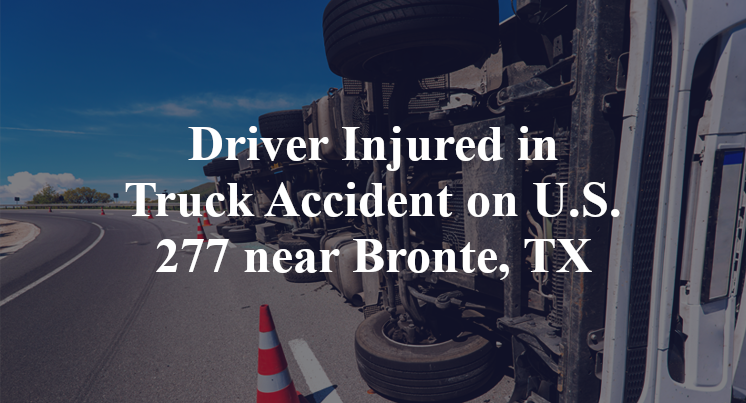
Officials indicate that, for as yet unknown reasons, the 18-wheeler failed to safely maintain control; it was consequently involved in a single-vehicle accident in which it apparently overturned, coming to a stop resting on its right side.
The driver reportedly sustained injuries of unknown severity over the course of the accident; they were transported to a local medical facility by EMS in order to receive necessary treatment. Additional details pertaining to this incident—including the identity of the victim—are not available at this point in time. The investigation is currently ongoing.
Commentary by Attorney Michael Grossman
When an 18-wheeler overturns on a rural highway with no other vehicles involved, the question isn’t just how the driver lost control—it’s why. Trucks don’t simply tip over without a triggering factor, and determining whether that factor was preventable is the focus of any meaningful investigation.
At this point, we don’t know if the truck encountered a sudden obstacle, suffered a mechanical failure, or if the driver made an overcorrection due to distraction or fatigue. What we do know is that the vehicle ended up on its side, which usually suggests either an abrupt steering input or instability caused by load shift, road edge drop-off, or excessive speed during a curve or lane departure.
That’s why investigators should be pulling the truck’s engine control module (ECM) data, checking for sudden brake or steering inputs, and reviewing cargo securement logs. If the load wasn’t properly distributed or tied down, even a minor swerve could cause enough imbalance to roll the truck—particularly if it was top-heavy or carried in a dry van with no internal bracing.
Driver condition matters here too. Was the driver well-rested, trained for the route, and familiar with the truck’s handling characteristics? In past cases I’ve handled, a single moment of inattention—often due to fatigue or looking down at a device—was enough to send a fully loaded truck off the road. If this driver had been behind the wheel for hours without a break, or if the company failed to enforce reasonable shift limits, that could be a significant factor.
Even tire blowouts or mechanical problems like brake failure or steering issues are worth considering—but those too raise questions about maintenance practices and inspection routines. If the carrier skipped steps or overlooked worn components, the blame doesn’t stop with the driver.
Key Takeaways:
- A truck rollover almost always involves a triggering factor—steering, speed, load shift, or mechanical failure.
- ECM data and cargo logs will help clarify whether the vehicle was stable and under control before the crash.
- Driver fatigue, distraction, or overcorrection should be evaluated using logs, communications, and phone records.
- Maintenance history and recent inspections must be reviewed if mechanical issues are suspected.
- Even without another vehicle involved, responsibility may lie with the driver, the company, or both depending on what the evidence shows.

 call us
  Email Us
  Text us