
West Palm Beach, FL —July 15, 2025, a motorcyclist was killed due to a truck accident at approximately 9:30 a.m. along Southern Boulevard.
According to authorities, the accident took place in the eastbound lanes of Southern Boulevard in the vicinity of Lang Road.
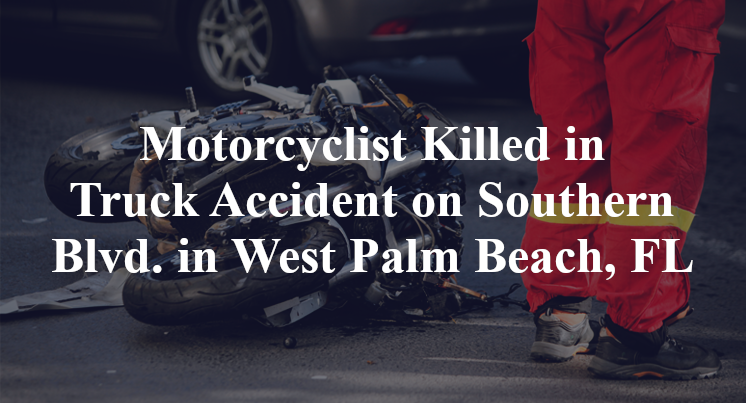
Details surrounding the accident remain scarce. Officials indicate that, for as yet unknown reasons, a collision took place between a motorcycle and an 18-wheeler. The person who had been on the motorcycle reportedly sustained fatal injuries due to the wreck and was declared deceased at the scene. Additional information pertaining to this incident—including the identity of the victim— is not available at this point in time. The investigation is currently ongoing.
Commentary by Attorney Michael Grossman
When a motorcyclist is killed in a crash involving an 18-wheeler, the most important question is how did their paths intersect—and did either party have time to prevent the collision? Motorcycles are small, fast, and difficult to see, while trucks are large, slow to maneuver, and carry major blind spots. That combination can turn an ordinary traffic maneuver into a deadly mistake if one driver misjudges speed, timing, or lane position.
With the limited details available here, it’s not yet clear who initiated the conflict. Was the truck turning across the motorcyclist’s lane? Was the motorcycle attempting to pass in the truck’s blind spot? Was traffic slowing or merging near the Lang Road area? These distinctions are critical, because they shape whether the motorcyclist was reacting to the truck’s movement—or vice versa.
From the truck driver’s perspective, it’s important to ask whether they had a clear view of the motorcycle. Large commercial trucks have significant blind spots, especially along the right side and near the rear wheels. In crashes I’ve worked where a motorcycle was struck during a lane change or turn, the truck driver often claimed they “never saw the bike.” That doesn’t automatically relieve them of responsibility—it just shifts focus to whether they checked mirrors, signaled properly, and executed the maneuver with caution.
For the motorcyclist, the key factor is often visibility and lane placement. If they were traveling in the truck’s blind spot or making an aggressive pass, that may have left the truck driver with no meaningful time to respond. But again, that can’t be assumed—it has to be proven through scene evidence, surveillance video, and witness accounts.
Until investigators confirm who moved where and when, the cause of this fatal crash remains an open question. What’s clear is that timing and line-of-sight likely played a central role in a wreck that didn’t have to happen.
Key Takeaways
- The investigation must determine which vehicle initiated the conflict—whether the truck turned into the motorcycle’s path or the motorcycle attempted a risky maneuver.
- Visibility is central: Did the truck driver have a chance to see the motorcycle, and did the rider have space to safely maneuver?
- Truck blind spots and motorcycle lane positioning often play a key role in determining fault.
- Surveillance footage, black box data, and physical evidence will be critical in reconstructing vehicle movements.
- Accountability will depend on whether one or both parties failed to anticipate or avoid an obvious hazard in real time.

 call us
  Email Us
  Text us