
UPDATE (March 27, 2025): Additional reports have been published in the news which state that the remains of three more people were discovered in the wreckage. Officials state that they have yet to be positively identified. Investigations remain ongoing.
UPDATE (March 17, 2025): Reports have recently been released which clarify some of the details pertaining to this incident. Contrary to preliminary reports, there were apparently only two deaths as opposed to the previously reported three. Those two victims have reportedly been identified as Juan Beltran Sanchez—from Chino Valley—and Evelyn Davis—from Ganado, Arizona. These reports also state that the multi-vehicle wreck was allegedly initiated when an 18-wheeler jackknifed in the snowy and icy conditions, blocking the westbound lanes of the freeway and resulting in multiple chain reaction collisions.
According to reports, there were a total of 22 vehicles—several of which were 18-wheelers—were involved in the wreck; sixteen victims were apparently injured and had to be transported to local medical facilities by EMS in order to receive treatment. No additional details are currently available. Investigations continue.
Williams, AZ — March 13, 2025, three people were killed following a multi-vehicle truck accident sometime in the afternoon along Interstate Highway 40.
According to authorities, the accident took place on I.H. 40 in the vicinity between Business Loop 40 and McLellan Reservoir.
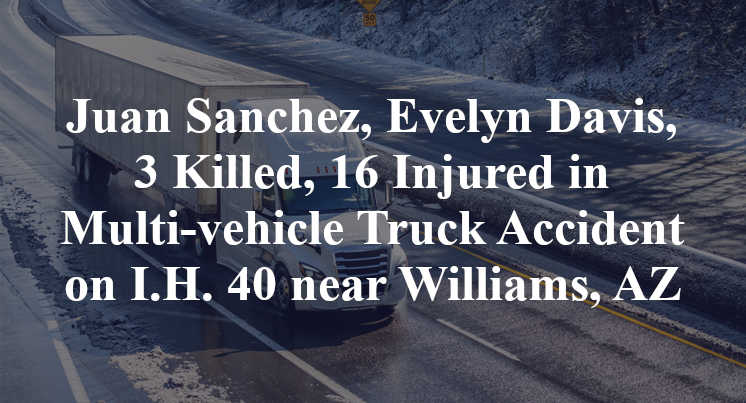
Weather and road conditions in the area were reportedly snowy. Details surrounding the accident, however, remain scarce. Officials indicate that, for reasons yet to be confirmed, a collision took place involving at least two 18-wheelers and an unknown number of passenger vehicles. Reports state that at least one of the 18-wheelers caught on fire over the course of the accident.
Three victims reportedly suffered fatal injuries due to the wreck. Additional information pertaining to this incident—including the identities of the victims—are not available at this point in time. The investigation is currently ongoing.
Commentary by Attorney Michael Grossman
When an 18-wheeler jackknifes and causes a massive chain-reaction crash, the key question isn’t just what happened, but why it happened. In my experience handling truck accident cases, wrecks like this rarely occur without multiple contributing factors that need to be examined.
Why did the truck jackknife? Professional drivers are trained to control their vehicles, even in difficult conditions. Investigators need to determine whether the driver braked too hard, was traveling too fast for conditions, or made a sudden maneuver that led to the loss of control. Reviewing dashcam footage, black box data, and driver logs could provide insight into what caused the truck to jackknife.
Did the truck’s cargo contribute to the loss of control? An improperly loaded or unbalanced trailer can increase the likelihood of jackknifing. If the truck’s cargo shifted or exceeded legal weight limits, that could have played a role in the wreck. Investigators should examine cargo manifests, weigh station records, and company policies on load securement to determine whether improper loading contributed.
Were the trucking companies enforcing safe driving practices? Trucking companies are responsible for ensuring their drivers follow industry best practices, including reducing speed and increasing following distance in hazardous conditions. If the drivers were under pressure to meet a deadline, had exceeded their allowed hours of service, or were operating without proper winter-driving training, investigators need to uncover those details. Reviewing company policies, safety records, and past violations could help determine whether the company played a role.
What caused the fire? Vehicle fires don’t typically occur unless there is a significant impact, fuel system failure, or mechanical defect. Investigators should determine whether the fire was caused by the crash itself or if improper maintenance or cargo played a role. Reviewing burn patterns, fuel system integrity, and manufacturer recall history could provide insight into whether the fire should have been preventable.
At the end of the day, the most important thing is finding answers. Even if it takes an independent investigation to gather the right evidence, it’s critical to examine every factor to ensure those affected by the crash get the clarity they deserve.

 call us
  Email Us
  Text us