
Atalla County, MS — July 25, 2025, John Hedges Jr. and Raul Rosquete were killed in a morning truck accident on State Highway 12 near Durant.
Authorities said two semi-trucks collided head-on near the border between Atalla and Holmes counties. One truck, a westbound Freightliner, was loaded logs, while the other, an eastbound Volvo, was carrying pipes. Both trucks caught fire after the crash, which also involved a third vehicle.
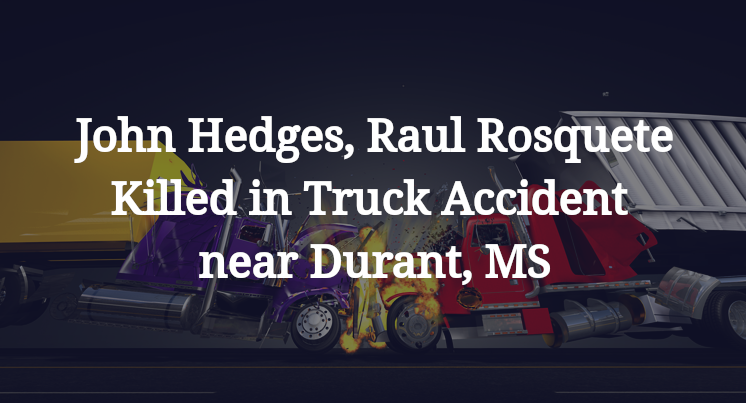
Both truck drivers died in the crash, according to authorities. John L. Hedges Jr., 45, of Kilmichael, MS, was driving the log truck, while Florida resident Raul Rosquete, 67, was driving the other truck.
The driver of the third vehicle was not hurt, authorities said.
Authorities have not released any additional information about the Atalla County crash at this time. The accident is still under investigation.
Commentary by Attorney Michael Grossman
When people hear about a head-on collision between two 18-wheelers, especially one where both vehicles catch fire and both drivers lose their lives, it’s natural to want clear answers: What went wrong? Was someone in the wrong lane? Was one of the loads unstable? Could this have been prevented?
Based on what’s currently known, we have a westbound log truck and an eastbound pipe-hauler colliding on State Highway 12 near the Atalla–Holmes county line. What’s missing from the reports is exactly how the two rigs came to be in each other’s path. Was one truck trying to pass? Did a tire blow out? Was there a steering failure or a driver distraction? These aren’t small details; they go straight to the heart of who might ultimately be responsible.
Depending on whether either truck veered out of its lane, different questions come into play. If the log truck crossed the center line, we’d want to know what the driver was doing at the time. Was he tired? Distracted? Was his vehicle equipped with a forward-facing dash camera or an in-cab monitoring system? If it had a functioning engine control module, essentially the truck’s black box, that data might show whether the driver braked, accelerated or turned in the moments leading up to the crash.
On the other hand, if the pipe truck was at fault, we’d want to explore not just the driver’s actions but how the cargo was secured. Pipe loads are heavy and cylindrical; by nature, they want to roll. If the load wasn’t secured properly, even a sharp brake or swerve could send the trailer off-course or contribute to a rollover or jackknife. In past cargo-related cases I’ve handled, the blame didn’t stop with the driver. It extended to whoever loaded the trailer, designed the route and authorized the truck’s departure. A pipe that shifts during transit can become a missile, and depending on the trailer setup, even a slight imbalance might compromise control.
At this point, we still don’t know whether cargo played any role here, or whether the fire came from the trucks’ fuel tanks, the cargo or some other source. The third vehicle’s involvement also hasn’t been explained. Was it simply caught in the aftermath, or did it play a role in how the crash unfolded?
Until investigators recover ECM data, cell phone records, camera footage and perhaps most importantly, statements from any surviving witnesses, there’s no way to draw firm conclusions. But I can say from experience that crashes like this rarely come down to a single mistake. They tend to involve a chain of oversights — by drivers, by their companies, by loaders — that all come together at the worst possible time.
Key Takeaways:
- It’s not clear which truck veered into the opposing lane, and that makes a big difference in assessing fault.
- ECM data, dash cams and cell phone records will be critical to understanding each driver’s actions before the crash.
- The cargo, logs and pipes, raises questions about how it was loaded and secured, and whether shifting loads contributed to the collision or fire.
- The role of the third vehicle remains unexplained; its involvement could affect how the sequence of events is understood.
- Determining responsibility requires gathering and analyzing hard evidence, not just relying on assumptions.

 call us
  Email Us
  Text us