
Harris County, TX — June 17, 2025, Harley Mikeska was injured due to a truck accident shortly after 6:15 a.m. along Sam Houston Parkway.
According to authorities, 31-year-old Harley Mikeska was traveling in an eastbound Honda Accord on Sam Houston Parkway in the vicinity west of the Sagehaven Drive intersection when the accident took place.
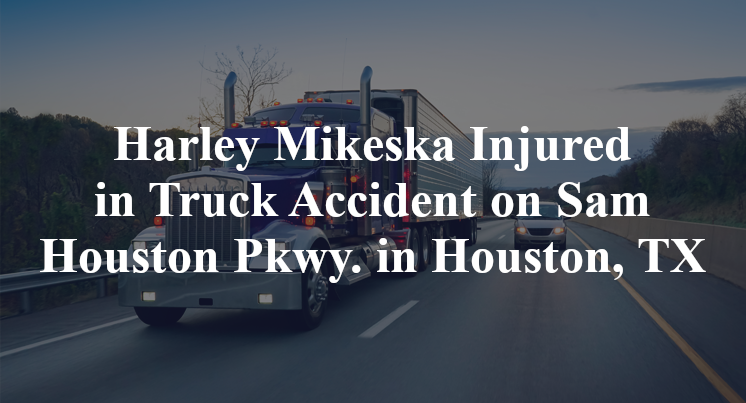
Officials indicate that, for as yet unknown reasons, an eastbound Volvo 18-wheeler with a trailer in tow had become disabled in the active lanes of the roadway. A collision followed between the front-end of the Honda and the rear-end of the semi-truck’s trailer.
Mikeska reportedly sustained serious injuries as a result of the wreck. It does not appear that anyone else was hurt. Additional details pertaining to this incident are not available at this point in time. The investigation is currently ongoing.
Commentary by Attorney Michael Grossman
When a passenger car crashes into the back of a disabled 18-wheeler sitting in an active travel lane, most people are quick to assume the car’s driver wasn’t paying attention. But that overlooks a critical issue: What was a full-length semi doing stopped in a live lane of traffic in the first place? That’s the question any serious investigation needs to answer first.
Trucks don’t just break down without warning. When they do, there are strict rules about what drivers must do to warn other motorists. Federal regulations require commercial drivers to activate their hazard lights immediately and, within ten minutes, place reflective triangles or flares behind the truck at specific intervals. Those aren’t optional steps—they’re the minimum standard for keeping others safe when a big rig becomes a stationary obstacle.
So far, there’s no public information about whether any of those warnings were in place. And that’s a problem. In early-morning light—around 6:15 a.m.—visibility can be inconsistent. Depending on weather, sun glare, or traffic flow, a stopped trailer in a live lane can be incredibly hard to detect until it’s too late to avoid. I’ve handled multiple cases where drivers were blamed for rear-end collisions, only to later prove that they never had a fair chance to react because the warning devices required by law were never set out—or weren’t visible in time.
It’s also worth asking why the 18-wheeler became disabled. Was it due to a mechanical failure the driver had already noticed? Was the vehicle overdue for service or being operated with known issues? If that truck shouldn’t have been on the road at all—or if the company cut corners on maintenance—that points to a level of responsibility beyond just the driver behind the wheel.
None of this shifts attention away from the injured motorist. The question is whether they were truly in a position to prevent the crash—or whether they were placed in a no-win scenario by a truck that was both disabled and improperly secured.
Key Takeaways
- A disabled 18-wheeler in an active travel lane raises immediate questions about visibility, maintenance, and warning protocols.
- Federal law requires hazard lights and reflective devices to be deployed within minutes of stopping—a key detail investigators should verify.
- Visibility conditions around 6:15 a.m. may have limited the driver’s ability to see and react to the stopped trailer in time.
- Mechanical records and service history for the truck may reveal whether preventable failures played a role.
- Determining fault requires more than assumptions—it requires a close look at whether everyone involved followed the rules designed to keep situations like this from turning dangerous.

 call us
  Email Us
  Text us