
Tarrant County, TX — August 24, 2024, Gerald Ricks was injured due to a motorcycle versus car accident just after 11:00 p.m. along North Main Street.
According to authorities, 55-year-old Gerald Ricks was traveling on a southbound Harley-Davidson motorcycle attempting to thread the lanes between two southbound passenger cars on Main Street in the vicinity north of Belknap Street when the accident took place.
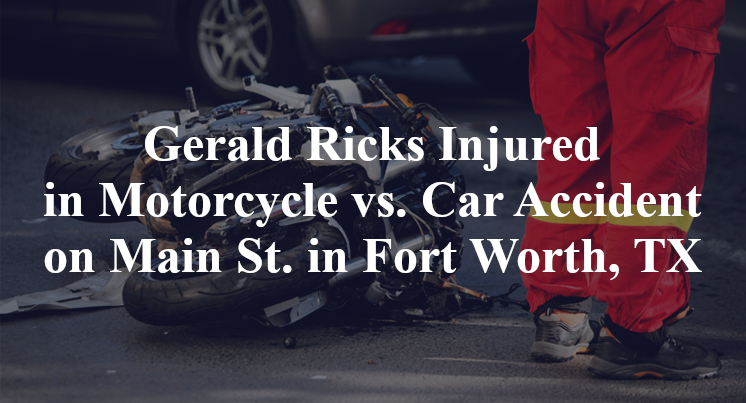
Officials indicate that, for as yet unknown reasons, the motorcycle was unable to safely complete the maneuver. A collision apparently took place between the motorcycle and the front fender of one of the vehicles. The impact caused the motorcycle to bounce off, leading to a secondary collision with the rear fender of the other motor vehicle.
Ricks reportedly sustained serious injuries as a result of the wreck. He was transported to a local medical facility in order to receive necessary treatment. No other injuries have been reported. Additional details pertaining to this incident are not available at this point in time.
Commentary by Attorney Michael Grossman
When a motorcyclist is seriously injured while maneuvering between vehicles, it’s easy to focus on the rider’s decision-making. But in any crash involving tight traffic and multiple points of contact, it’s important to ask whether something else made that maneuver more dangerous than expected.
Did the authorities thoroughly investigate the crash?
In a lane-splitting scenario, the margin for error is small—but that doesn’t mean the investigation should be. Did officers determine how fast each vehicle was moving and whether the motorcycle had enough space to safely pass through? Were the distances and damage points accurately mapped? Understanding exactly where and how contact occurred is key to separating aggressive riding from an unexpected change in vehicle positioning or a narrowing of space.
Has anyone looked into the possibility that a vehicle defect caused the crash?
If the motorcycle struck one car and was then deflected into another, it’s fair to ask whether the bike or either vehicle malfunctioned in some way. Was the Harley’s throttle or brake response appropriate for the situation? Did either of the cars unexpectedly veer or decelerate due to a mechanical issue? A full inspection of the motorcycle and both passenger vehicles is the only way to rule out mechanical causes that could have escalated the situation.
Has all the electronic data relating to the crash been collected?
Depending on their model years, the cars involved may contain event data recorders that show speed, braking, and steering input at the time of the crash. If either vehicle moved unexpectedly, that data could confirm it. For the motorcycle, while event data may be more limited, aftermarket GPS or rider tech might still capture speed or positioning. In an urban area like North Main Street, security or traffic cameras could also offer a clear visual of what happened—something that can resolve disputes about timing or space.
Even when a rider initiates a risky maneuver, the outcome still depends on what all vehicles involved were doing at the time. That’s why every angle needs to be examined—especially when the injuries are serious and the circumstances are complex.
3 Key Takeaways:
- Crashes during lane-splitting must be reconstructed to determine spacing, timing, and movement of all vehicles.
- Mechanical issues on any involved vehicle could have contributed and must be ruled out through inspection.
- Vehicle data and urban surveillance footage can help clarify how and why the crash unfolded.

 call us
  Email Us
  Text us