
Tillmans Corner, AL — May 22, 2025, a man was injured in a truck versus dump truck accident sometime in the morning along Three Notch Road.
According to authorities, the accident took place on Three Notch Road in the vicinity of the Emerald Drive intersection.
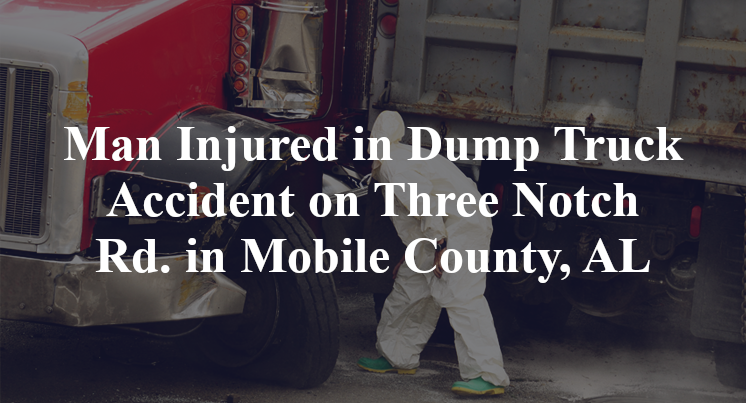
Details surrounding the accident remain scarce. Officials indicate that, for as yet unknown reasons, a head-on collision took place between a truck and a dump truck.
The man who had been behind the wheel of the truck was apparently entrapped in the wreckage and had to be extricated by emergency personnel. Once freed from the aftermath, he was transported to a local medical facility by EMS in order to receive immediate treatment for the critical injuries he incurred over the course of the accident. Although the dump truck overturned, the woman who had been behind the wheel was apparently unhurt.
Additional details pertaining to this incident—including the identity of the victim—are not available at this point in time. The investigation is currently ongoing.
Commentary by Attorney Michael Grossman
When readers hear about a head-on collision involving a truck and a dump truck, the immediate question on most people’s minds is: How could something like that happen? It’s a fair question—especially when one driver ends up critically injured and the other walks away without a scratch.
Right now, the details we’ve been given are thin. We know a dump truck overturned, a man had to be cut from the wreckage of a pickup or smaller truck, and the crash was head-on. But that’s about it. And without more information, we’re left with a lot of unanswered questions—questions that are crucial for anyone trying to understand responsibility.
The Missing Pieces That Determine Accountability
The central mystery here is how a head-on crash occurred. Did one vehicle cross the center line? If so, why? Was the driver distracted? Did something mechanical fail? Or was the road itself a factor?
To get to the truth, investigators need to look beyond the crumpled metal and overturned dump truck. This includes:
- Cell phone records, to see if a driver was distracted.
- Dash camera footage, which could show how the crash unfolded.
- Engine control module (ECM) data, often called the truck’s “black box,” to reveal the speed, braking, and steering inputs just before impact.
- In-cab cameras, if available, to help determine whether fatigue, distraction, or even a medical episode was at play.
These kinds of tools aren’t just bells and whistles—they’re the foundation of an evidence-based investigation.
When the Cause Isn’t Just the Driver
Assuming one vehicle crossed into the other’s lane, that still doesn’t tell us why it happened. And “why” is everything. In my experience, I’ve handled cases where the root cause wasn’t just a driver’s mistake, but deeper problems in the company’s hiring and oversight practices.
If one of these vehicles was operated by a commercial trucking company—especially the dump truck—it’s worth asking:
- Did the company properly vet and train their driver?
- Were they pushing the driver to meet an unreasonable schedule?
- Was the truck maintained and inspected regularly?
The driver may have been the last link in the chain, but they’re rarely the only one.
Key Takeaways
- The most important question—how the head-on collision occurred—remains unanswered.
- Evidence from cell phones, in-cab cameras, and ECMs will be vital to understanding the sequence of events.
- Determining liability may require looking at driver conduct and company practices.
- An independent investigation will be necessary to get the answers that matter—not just for legal accountability, but for clarity about what went wrong.
- Until the facts are fully gathered and examined, it’s too early to assume who was at fault.
We won’t know who’s responsible until all the evidence is on the table. But I can say this with certainty: accidents like these don’t just “happen.” There’s always a cause—and someone accountable for it.

 call us
  Email Us
  Text us