

Mahnomen, MN — July 9, 2025, at least one person was killed due to a dump truck accident at approximately 2:00 p.m. along Interstate Highway 59.
According to authorities, a 56-year-old man from Detroit Lakes was traveling southbound in a dump truck while a 22-year-old man from Thief River Falls was traveling northbound in an SUV on I.H. 59 in the vicinity north of S.H. 200 when the accident took place.
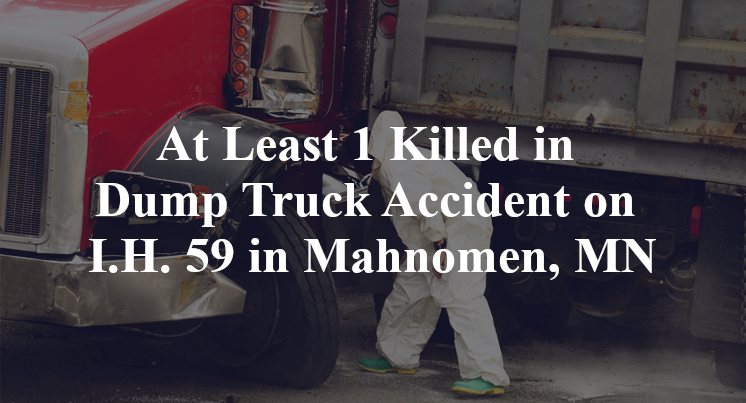
The cause of the accident remains unclear. Officials indicate that, for as yet unknown reasons, head-on collision took place between the two vehicles because one vehicle failed to safely maintain its lane of travel. It has not been made clear which vehicle is at fault. At least one person reportedly sustained fatal injuries due to the wreck. Additional details pertaining to this incident—including the identity(s) of the victim(s)—are not available at this point in time. The investigation is currently ongoing.
Commentary by Attorney Michael Grossman
When a dump truck and an SUV collide head-on along a two-lane highway, the question isn’t simply who crossed the line—it’s why did that happen, and was there any chance to stop it before impact? On straight, rural roads like Interstate 59 near State Highway 200, there’s usually a clear line dividing travel directions. When two vehicles meet in the same lane, one of them failed to stay where they belonged—but determining which one requires more than assumption.
Right now, authorities haven’t confirmed which driver crossed the centerline. That makes physical evidence—like tire marks, impact location, and vehicle resting positions—essential. Skid marks that begin in one lane and end in another often tell a clearer story than any witness account. Likewise, damage patterns can reveal the angle of impact and help reconstruct each driver’s final maneuver.
It’s also critical to consider what may have caused a vehicle to leave its lane. Was there a medical emergency? A moment of distraction? A mechanical failure like a tire blowout or steering issue? These questions aren’t hypothetical—they shape how fault is determined. In past cases I’ve handled, a head-on collision turned out to be the result of a tire delamination, where the driver never had a chance to correct before the vehicle veered uncontrollably.
If the dump truck crossed over, there may be questions about load balance, brake condition, or fatigue—especially given the long hours and demanding routes commercial drivers often face. If the SUV was at fault, investigators will still need to examine possible distractions, speed, or impairment. Either way, black box data (if available) and mechanical inspections will be crucial.
What matters most is not just assigning fault, but understanding whether this was a momentary lapse—or something preventable with better maintenance, awareness, or caution.
Key Takeaways
- The core issue is which vehicle failed to maintain its lane and why—something physical evidence at the scene will be critical in determining.
- Tire marks, vehicle damage, and resting positions will help reconstruct the point of impact and each driver’s last movements.
- Investigators should examine mechanical failures, driver fatigue, or distraction as possible causes of lane departure.
- Black box data and vehicle inspections are essential, particularly if the dump truck was operating under commercial conditions.
- Responsibility in a head-on crash isn’t just about where the vehicles ended up—it’s about why one left its lane and whether anything could have prevented it.
 call us
  Email Us
  Text us