
Napoleon, ND — May 17, 2025, One person was injured following a cattle truck accident that occurred Saturday morning on Highway 34.
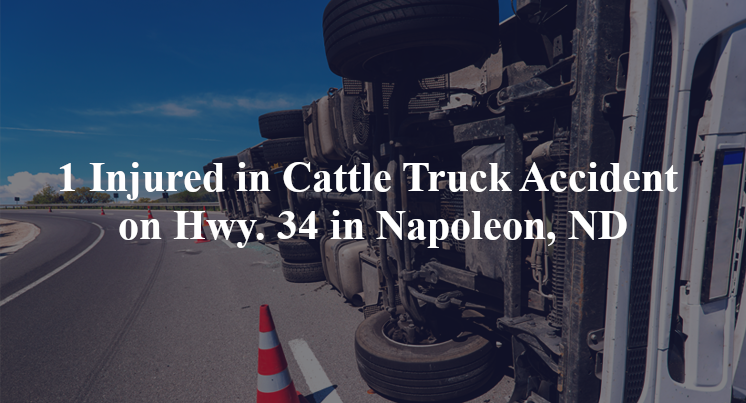
According to official reports, sometime Saturday morning an 18-wheeler hauling cattle hit an approach and crashed as it was traveling eastbound on Highway 34 resulting in serious damage to the truck, though no other vehicles were reportedly involved.
When emergency crews arrived on scene they found the driver injured and transported them to the hospital, while injured cattle were taken to an animal hospital for treatment. Officials have not released a cause of the accident, and the identity and injury status of the driver remains unknown during this ongoing investigation.
Commentary by Attorney Michael Grossman
When people hear about a truck crash involving a load of cattle, their first question is often the most natural: How could something like this happen without anyone else involved? If no other vehicle hit the truck, then what went wrong? Was it driver error, a mechanical failure, or something related to the load itself? These aren’t just idle curiosities—they’re the key to finding out who, if anyone, should be held accountable.
What We Know—and What We Don’t
According to reports, the 18-wheeler was traveling east on Highway 34 when it struck an “approach” and crashed. The term “approach” is vague—it could mean an elevated driveway, a bridge entry point, or some kind of off-road embankment. Without more detail, it’s hard to say whether the truck veered off course or the road design itself contributed to the incident.
It’s also unclear whether the truck was already in distress (for example, braking hard, swerving, or experiencing a mechanical issue) before the impact. Since no other vehicles were involved, many might assume this was purely driver error—but that would be premature. A thorough investigation would need to answer a number of unanswered questions:
- Was the driver fatigued or distracted, perhaps using a phone?
- Did the truck’s brakes or steering fail?
- Was the cargo loaded in a way that made the vehicle unstable?
- What does the truck’s engine control module (black box) say about speed, braking, or mechanical failures at the time of the crash?
These questions matter because depending on the answers, the responsibility could lie with the driver, the trucking company, the cargo loaders, or even a third party like a maintenance provider.
The Role of Technology and Policies
If this truck was equipped with in-cab cameras or an ECM, then investigators could already have a good deal of objective data to work with. Likewise, a review of the driver’s hiring, training, and driving history might reveal whether this was a one-off mistake or something that should’ve been prevented before the truck ever hit the road.
I’ve handled cases where companies hired drivers with questionable records, ran inadequate background checks, or performed rushed road tests that didn’t actually test a driver’s ability to handle a full-size rig under real-world conditions. In those situations, the crash wasn’t just about what happened that day—it was about a string of bad decisions that led up to it.
We also can’t ignore the livestock angle. Livestock trailers are notorious for load shifts when animals move during transit. If the cattle weren’t properly secured or the trailer wasn’t appropriate for the load, that could have destabilized the truck, especially if the driver had to make a sudden maneuver.
Key Takeaways
- It’s not clear whether the crash resulted from driver error, road design, mechanical failure, or a cargo issue involving the cattle.
- Black box data, in-cab cameras, and driver phone records could be key to understanding what happened.
- Depending on the circumstances, fault might rest not just with the driver but potentially with the trucking company, cargo handlers, or maintenance providers.
- Livestock movement inside the trailer may have contributed to instability, raising questions about trailer suitability and loading practices.
- The truth of what happened depends on a thorough investigation—and until that happens, blaming any one party is speculative at best.

 call us
  Email Us
  Text us