
Marana, AZ — April 1, 2025, four people were injured in a bus accident at about 1:40 p.m. on Interstate 10 near West Tangerine Road.
Authorities said a 2012 Volvo XC60 was headed east in the middle lane when it changed lanes and crashed into the side of a school bus. The bus overcorrected after the collision, crossing all three lanes of traffic before it spun around and fell in its side in the median.
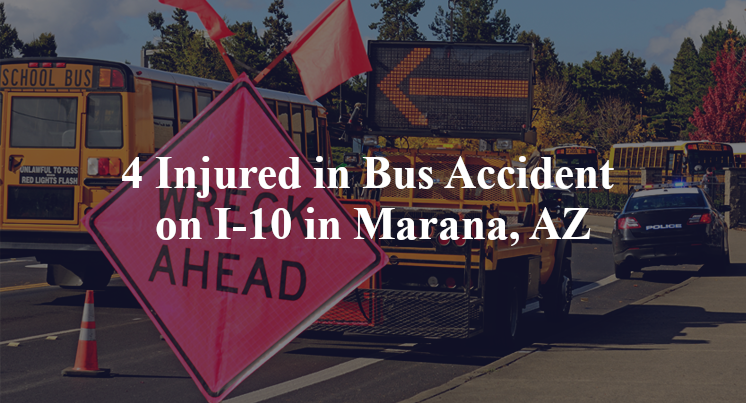
The bus was carrying about 40 students and chaperones from Kingman Unified School District who were traveling to a Future Business Leaders of America competition in Tucson, according to news reports.
School officials said two students and two staff members were hospitalized after the crash, while authorities indicate three people suffered serious injuries.
The Volvo driver is facing three counts of aggravated assault, according to authorities. He allegedly tested positive for marijuana after the crash.
Authorities have not released any additional information about the Pima County crash at this time. The crash is still under investigation.
Commentary by Attorney Michael Grossman
When a school bus ends up overturned in the median of an interstate highway, the first concern is always the people on board, but the next question has to be: What set this entire chain of events in motion? Based on what’s been reported, the answer in this case points to the actions of the driver of a Volvo SUV who allegedly changed lanes into the side of the bus. What followed was a high-speed overcorrection, a full cross of the highway, and a rollover that injured multiple people, including students and school staff.
The fact that authorities have already charged the SUV driver with aggravated assault — and that he reportedly tested positive for marijuana — tells us a lot about how seriously this incident is being viewed. From a legal standpoint, operating a vehicle under the influence of any impairing substance, especially on a highway, is a major breach of the duty of care all drivers owe to others. When that breach involves a school bus carrying nearly 40 people, the stakes couldn’t be higher.
That said, it’s also important to examine the bus driver’s response to the impact. Was the overcorrection avoidable, or was it a split-second reaction to a vehicle suddenly intruding into the lane? Did the bus have any mechanical limitations or handling characteristics that made recovery more difficult? These are critical questions because they help determine whether the rollover was an inevitable result of the initial collision, or if there were other contributing factors.
Investigators will need to pull dashcam footage, GPS data and any available eyewitness accounts to reconstruct what happened in those crucial few seconds.
One additional layer to consider is the responsibility of the school district and transportation provider. Any crash involving student transport brings up questions about seat belts, vehicle maintenance and emergency procedures. Were passengers properly secured? Was the bus equipped to handle a crash of this magnitude? These questions may not change who’s at fault for starting the crash, but they do matter in terms of minimizing harm once the worst occurs.
At the heart of this is a legal principle that applies to everyone on the road: you’re responsible not just for your own safety, but for how your actions affect others. When someone allegedly drives under the influence and makes an unsafe lane change, and that decision causes a school bus to flip across a highway, the consequences aren’t just serious, they’re the kind that demand full accountability. And that starts with a thorough, evidence-based investigation into every moment that led to this crash.

 call us
  Email Us
  Text us