
Newton, MS — December 21, 2024, Amarnath Thirumalaiyer and Sujatha Amarnath were killed in a truck accident on Interstate 20.
Authorities said a 2023 Honda was involved in a multi-vehicle accident near mile marker 114 in Newton County, then the car was hit by a semi-truck.
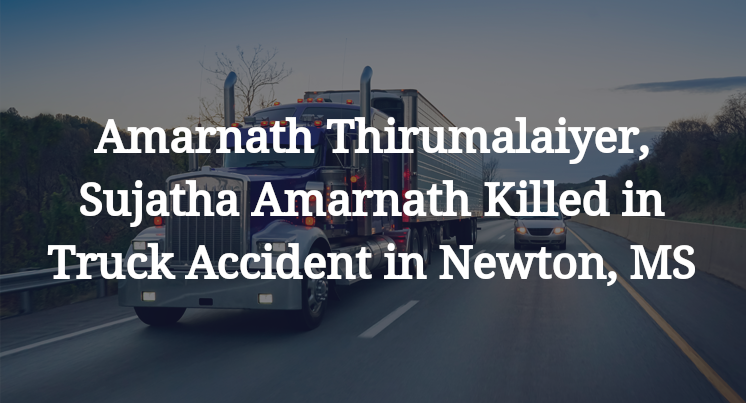
Allen, TX residents Amarnath Thirumalaiyer, 67, and Sujatha Amarnath, 56, died in the semi-truck crash, according to authorities.
No additional information about the crashes has been released at this point.
The accident remains under investigation.
Commentary by Attorney Michael Grossman
This incident underscores the serious consequences of collisions involving semi-trucks, particularly in multi-vehicle scenarios. It also highlights the need for a thorough investigation to determine all contributing factors and assign responsibility appropriately.
The initial crash involving the Honda raises several questions. Was the Honda already stopped on the highway? If so, why, and for how long? Did other vehicles collide with the Honda before the semi-truck arrived? Determining whether earlier impacts rendered the Honda immobile is critical to understanding why it was in the path of the semi-truck. Forensic evidence from the crash scene, including skid marks, vehicle positions, and damage patterns, will help reconstruct the sequence of events.
Given the severity of the crash, investigators must closely examine the semi-truck driver’s actions. Was the driver distracted? Cell phone records, in-cab cameras, and eyewitness accounts can provide clarity. Did the driver have sufficient time to react? The truck’s engine control module (ECM) can reveal speed, braking activity, and throttle data leading up to the crash. Was the driver fatigued or impaired? Hours-of-service logs and toxicology reports are crucial to ruling out violations of federal regulations or impairment.
The conditions on Interstate 20 at the time of the crash also require scrutiny. Were there any contributing environmental factors? Poor lighting, inclement weather, or road debris may have played a role. Was the crash scene adequately marked? If earlier collisions left the Honda stationary, were warning signals or emergency measures in place to alert approaching drivers?
The trucking company’s policies and practices may also have contributed to the crash. Was the driver adequately trained for scenarios like navigating a crash scene on a highway? Was the semi-truck in proper working condition? Faulty brakes or tires could delay reaction times, exacerbating the crash.
If the semi-truck driver’s actions or the trucking company’s practices are found to be negligent, they could be held liable for the deaths of the Honda occupants. Liability may hinge on the driver’s attentiveness and ability to react, as well as the company’s compliance with federal safety standards, including vehicle maintenance and driver training.
Mississippi follows a pure comparative negligence standard, meaning fault may be apportioned among multiple parties. For example, if the initial crash rendered the Honda immobile in a high-speed travel lane, fault may be divided among those responsible for that earlier event. However, the semi-truck driver and their employer could still bear significant liability if they failed to respond appropriately to a foreseeable hazard.
This case demonstrates the importance of thoroughly investigating not just the semi-truck driver’s actions but also the circumstances leading to the Honda’s involvement in a multi-vehicle collision. For the families involved, the primary goal is to uncover the full scope of what happened and why. Only a comprehensive investigation that goes beyond the immediate crash scene can provide those answers and help prevent similar events in the future.

 call us
  Email Us
  Text us