
Roane County, TN — December 20, 2024, three people were injured in a truck accident at about 9:20 a.m. on Interstate 40 near Rockwood.
Authorities said a 2022 Freightliner semi-truck crashed into the trailer of a 2005 Chevrolet 3500 that was stopped in traffic due to an armed standoff that had forced the closure of the interstate nearby.
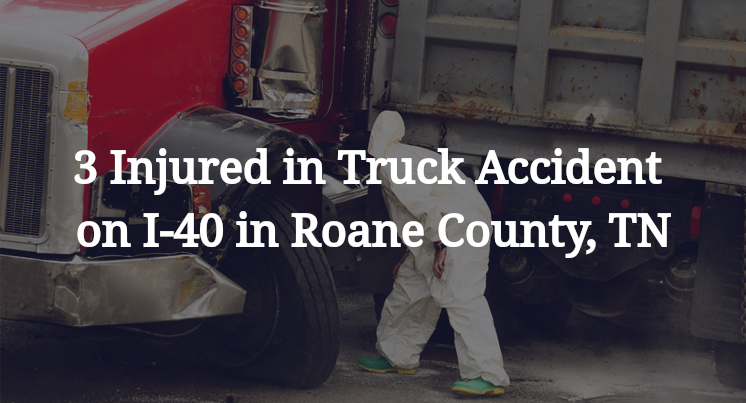
The impact caused the Chevrolet’s trailer to hit the trailer of a 2022 Volvo truck before it jackknifed and crashed into a 2021 Chevrolet Blazer that had been stopped on the side of the road, according to authorities.
The Freightliner also crashed into the Volvo and a 2015 Kenworth semi-truck, authorities said, coming to rest across both lanes of traffic. Debris from the crash also damaged a 2020 Honda Ridgeline. which ended up in a ditch.
The driver of the Freightliner and a passenger were injured in the crash, as was a passenger in the Chevrolet 3500, according to authorities, but their injuries were not thought to be serious. Their names have not been released at this time.
The crash remains under investigation.
Commentary by Attorney Michael Grossman
This crash raises a number of questions in my mind due to the unique circumstances at work here.
The Freightliner’s role as the initiating vehicle in this chain-reaction crash raises questions about the driver’s behavior and the vehicle’s condition. Was the driver distracted or inattentive? Investigators should review cell phone records, in-cab cameras, and witness statements to rule out distraction or fatigue. Did the driver attempt to brake? The Freightliner’s engine control module (ECM) will provide critical data on speed, braking activity, and throttle use before the collision. Was the driver adequately trained for high-pressure situations like sudden traffic stoppages? Training deficiencies or lapses in judgment can point to broader issues of employer negligence.
The unusual circumstances of an armed standoff and its resulting traffic closure add a layer of complexity. Were drivers given adequate warning of stopped traffic ahead? The presence or absence of signage, traffic control measures, or police alerts could affect liability. Did the Freightliner driver have sufficient time to react? Visibility, road conditions, and congestion levels at the time of the crash are all critical factors.
Mechanical failure cannot be ruled out until the Freightliner undergoes a thorough inspection. Brake System: Did the Freightliner’s brakes fail or perform inadequately due to maintenance issues or defects? Load Balance: Was the Freightliner carrying an improperly balanced or unsecured load that hindered its braking or maneuvering ability?
Chain-reaction crashes like this one often lead to compounded damage, raising questions about each driver’s response. Was the Chevrolet 3500’s trailer properly secured and its position visible to approaching drivers? Were the operators of the Volvo and Kenworth trucks able to mitigate damage through evasive actions, or were they also caught by surprise due to traffic conditions?
If the Freightliner driver is found to have acted negligently—by speeding, failing to brake, or driving while distracted—the trucking company could share liability under vicarious liability principles. Additionally, the company may bear direct liability for inadequate driver training or poor vehicle maintenance.
Tennessee’s modified comparative negligence standard will apportion fault among all responsible parties. For example, if inadequate traffic control measures contributed to the crash, local authorities or contractors could bear partial responsibility. If the operators of other vehicles in the chain-reaction crash were negligent in securing their loads or taking evasive action, they might also be found partially liable.
The armed standoff’s influence cannot be ignored. If traffic was mismanaged or stopped without sufficient warning, questions could arise about whether law enforcement or emergency responders contributed to the conditions leading to the crash.
This crash is a complex scenario that demonstrates how external factors and cascading failures can compound risks on busy highways. A thorough investigation must focus not only on the Freightliner driver’s actions but also on the traffic conditions, mechanical factors and the broader context of the armed standoff. For those injured, a complete understanding of the crash’s causes will be essential to ensure accountability and identify measures to prevent similar incidents in the future.

 call us
  Email Us
  Text us