
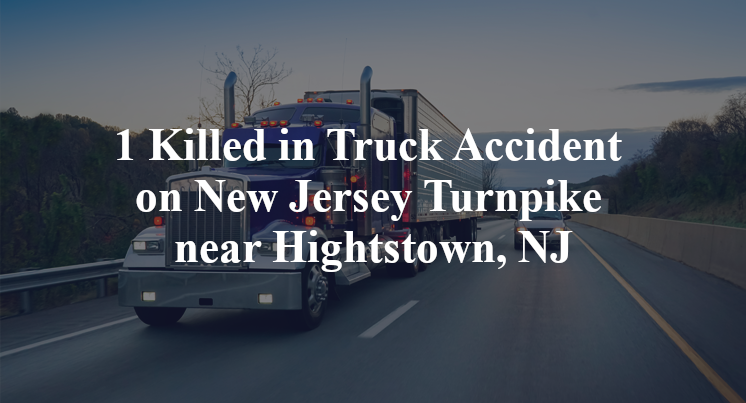
Mercer County, NJ — August 7, 2025, one person in a truck accident at about 10:30 a.m. on Interstate 96/New Jersey Turnpike in East Windsor Township.
Authorities said a Kenworth semi-truck collided with a Ford F-150 and a Mercedes-Benz sedan while heading south near mile marker 68.2. The impact forced the pickup into a Freightliner tractor-trailer, while one of the smaller vehicle’s wheels came off and hit a Ford van.
The pickup driver, whose name has not been made public yet, died after the vehicle caught fire, according to authorities.
The drivers of the van and Mercedes sedan suffered minor injuries in the crash near Hightstown, authorities said.
Authorities have not released any additional information about the Mercer County crash at this time. The accident is still under investigation.
Commentary by Attorney Michael Grossman
When people read about a fatal crash involving multiple vehicles on the New Jersey Turnpike, they naturally want to know: How could something like this happen? Who’s really responsible? And are we getting the full picture?
Based on the initial reports, it appears a southbound Kenworth semi-truck collided with two smaller vehicles, a Ford F-150 pickup and a Mercedes sedan. The pickup was then pushed into another 18-wheeler, and debris from the impact even struck a fourth vehicle. One person lost their life, and others were injured. But from a legal standpoint, the news coverage leaves us with more questions than answers.
For starters, we don’t yet know what set this entire sequence in motion. Did the Kenworth driver fail to keep a proper lookout? Was there a sudden lane change or unsafe merge? Or could one of the smaller vehicles have cut in front of the truck? Each of those possibilities would point the finger in a different direction, and they all need to be investigated thoroughly.
We also don’t have any information yet about the speed of any of the vehicles, whether there were distractions involved (like a cell phone) or if mechanical failure played a role. Those are exactly the types of questions that can be answered through things like black box data, dash cam footage and in-cab cameras, if the trucking companies preserve them. In some of the cases I’ve handled, what appeared at first to be an unavoidable “chain reaction” turned out to be the result of preventable mistakes once we reviewed those electronic records.
Another major question here involves the fire that killed the pickup driver. Fires after a crash don’t just happen without a trigger. Was there a punctured fuel tank? A short-circuit? Was cargo involved in spreading the flames? Depending on how the fire started, that could raise separate questions about vehicle design or how the load was secured.
I’ve handled cases where a crash turned fatal not because of the collision itself, but because of what followed, whether that was a fire, spilled cargo or inadequate emergency response. These situations require a careful forensic investigation that goes far beyond what most police departments are equipped to do on their own.
At the end of the day, understanding what happened here, and holding the right people accountable, depends on answering questions that the public record hasn’t yet addressed. That means digging into hiring records, driver logs, maintenance reports and load manifests, not just crash scene photos.
Key Takeaways:
- It’s still unclear what caused the initial impact involving the Kenworth truck.
- Black box data, dash cams and driver phone records are critical to determining fault.
- The fire that killed the pickup driver raises additional unanswered questions about vehicle safety and cargo.
- A thorough investigation must consider whether any trucking company policies or hiring decisions contributed to the wreck.
- True accountability depends on gathering, and preserving, evidence before it disappears.

 call us
  Email Us
  Text us