
Montgomery County, TX — January 1, 2025, a man was injured following a truck accident shortly after 4:30 a.m. along Interstate Highway 45.
According to authorities, a 27-year-old man was traveling in a northbound Jeep Grand Cherokee on I.H. 45 in the vicinity north of Farm to Market 830 when the accident took place.
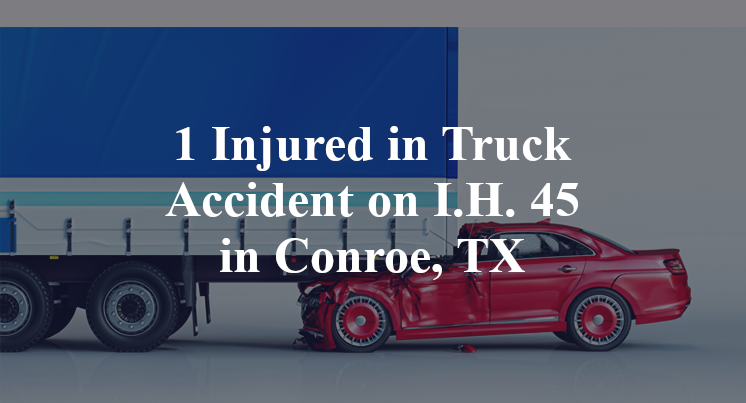
The cause of the accident remains unclear. Officials indicate that, for as yet unknown reasons, a collision took place between the front-end of the Jeep and the rear-end of a trailer being hauled by a work truck. The man from the Jeep reportedly sustained serious injuries due to the wreck. It does not appear that anyone else was hurt. Additional details pertaining to this incident are not available at this point in time. The investigation is currently ongoing.
Commentary by Attorney Michael Grossman
When a crash occurs on a highway in the early morning hours and involves a collision with a work truck’s trailer, it’s tempting to view it as a case of simple inattention or following too closely. But in my experience, the truth behind these incidents is rarely so simple. Especially when serious injuries are involved, as in this case from Montgomery County, the only responsible course of action is to ask three crucial questions that help reveal what actually happened—and why.
First, did the authorities conduct a thorough investigation? A rear-end collision often leads to assumptions about the trailing driver’s behavior, but those assumptions can be misleading without a careful analysis of the facts. What were the lighting and weather conditions like at the time? Was the trailer properly lit and marked? Was it moving at highway speed or slowing down—or was it stopped entirely in a live lane? These details matter, and a proper investigation should include documentation of the crash scene, inspection of the trailer’s visibility features, and recovery of any traffic or surveillance footage. If investigators didn’t have time to fully analyze those factors, an independent review may be necessary to get to the truth.
Second, has anyone considered whether a vehicle defect contributed to the crash? At highway speeds, a split-second delay in braking or a steering malfunction could prevent a driver from avoiding a collision—even if they reacted appropriately. If the Jeep Grand Cherokee experienced a mechanical failure, that would be critical to know, and such issues often require a forensic inspection to uncover. At the same time, defects in the trailer—such as non-working lights or inadequate reflectors—could have made it effectively invisible in low-light conditions. If either vehicle is moved or repaired before these possibilities are investigated, that evidence may be lost forever.
Finally, has all available electronic data been collected? Most modern vehicles, including the Grand Cherokee, are equipped with event data recorders that capture critical information like speed, throttle input, and braking in the moments leading up to a crash. That data can help show whether the driver attempted to avoid the collision or whether the vehicle’s systems functioned correctly. Investigators should also seek out dashcam footage, nearby surveillance video, and GPS or phone data to help reconstruct the timing and movement of both vehicles. In cases like this, digital evidence is often the only way to fill in the gaps left by physical damage and incomplete witness accounts.
Answering these three questions is critical to making sure that no stone is left unturned in understanding the causes of a crash like this. Serious wrecks deserve serious investigation, not assumptions. Getting clear answers to these questions is crucial for those seeking to understand what happened and why—and it’s the least that can be done to help those affected find the clarity and closure they deserve.

 call us
  Email Us
  Text us