
Aberdeen, MD — May 26, 2025, a motorcyclist was killed in a truck accident at about 8 p.m. on U.S. Route 40/South Philadelphia Boulevard.
Authorities said a motorcycle was headed east on Old Philadelphia Road when it turned onto the highway, where it was hit by a westbound semi-truck.
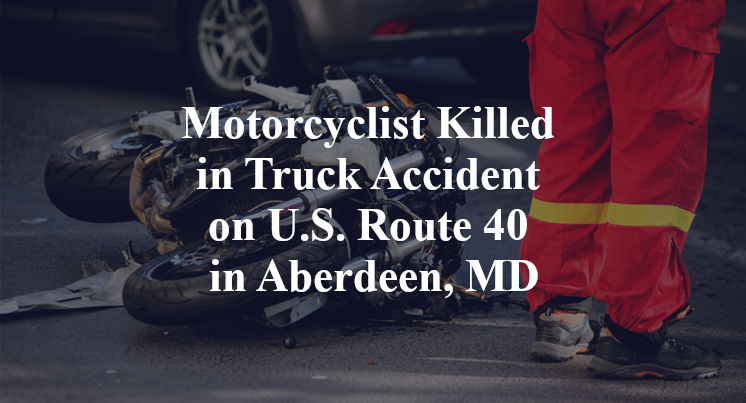
The motorcyclist, whose name has not been made public at this time, was pronounced dead at the scene of the crash, according to authorities.
Authorities have not released any additional information about the Harford County crash. The accident is still being investigated.
Commentary by Attorney Michael Grossman
When a motorcycle is hit by a semi-truck, most people’s first question is: How could that happen? Was the truck driver not paying attention? Did the motorcyclist pull out too suddenly? These are exactly the right questions to ask, but the answers don’t come from assumptions. They come from evidence.
Right now, we know a motorcycle was entering the highway and was struck by a westbound semi. That could mean a lot of things. Was the motorcyclist merging cautiously and misjudged the gap? Or did the truck driver fail to yield or react in time? Was the motorcyclist even visible to the truck driver at the moment of impact? Depending on the speed, angle and lighting at the time, each of those scenarios raises different legal and factual questions.
One of the first steps in making sense of a crash like this is to secure and analyze the truck’s black box, what’s officially called the engine control module (ECM). It tracks things like speed, braking and throttle position in the moments leading up to the collision. That alone can tell us whether the truck driver had time to react, or even tried to.
In-cab cameras are another piece of the puzzle. Many trucks these days are equipped with forward-facing and driver-facing cameras. If those were running, they might show whether the driver was distracted, fatigued or simply didn’t see the motorcycle. And of course, phone records can also reveal if the driver was on a call or texting during those critical moments.
On the other side of the equation is the question of visibility and timing. Was there a blind spot where the motorcyclist came onto the highway? Was the intersection well-lit? Did the motorcyclist have a clear view of oncoming traffic, or was the layout of the road such that the truck only became visible once it was too late?
And none of this even touches on the hiring and training practices of the trucking company. I’ve handled cases where a truck driver with a history of bad decisions was put behind the wheel again because the company didn’t do its due diligence. So it’s fair to ask: What steps did this company take to vet and prepare its driver for the road?
Right now, the public only knows the broad strokes of what happened. But from a legal standpoint, those strokes are far too broad to assign blame. Getting to the truth means piecing together electronic data, physical evidence and policy decisions. That’s what a real investigation should focus on; not who seems more likely to be at fault, but who actually made the critical mistakes that led to this fatal crash.
Key Takeaways:
- The central question is whether the semi-truck driver could have avoided the motorcycle after it entered the highway.
- Black box data, dash cam footage and phone records are vital for reconstructing the crash and assigning responsibility.
- Visibility, lighting and road layout will factor into understanding the motorcyclist’s decision to merge.
- A full investigation should also examine the trucking company’s training and hiring practices.
- Without these facts, it’s impossible to determine who is truly at fault.

 call us
  Email Us
  Text us