
Tarrant County, TX — September 20, 2024, three people were injured due to a motorcycle versus car accident at approximately 11:30 p.m. along Main Street.
According to authorities, a 20-year-old man from Euless was traveling on a northbound Yamaha motorcycle on Main Street at the Denton Drive intersection when the accident took place.
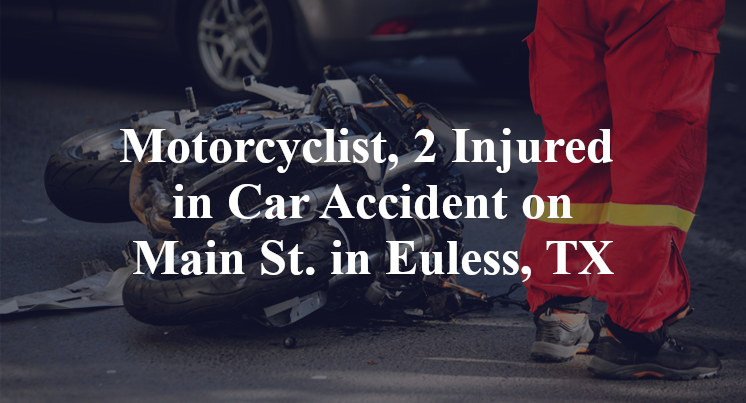
The intersection is apparently controlled by a traffic signal. Officials indicate that, for as yet unknown reasons, a collision took place between the front-end of the motorcycle and the front-right side of a southbound Ford Fusion occupied by a 16-year-old girl that had been attempting a left turn to head east on Denton. The impact caused the Fusion to swerve left, resulting in a secondary collision with a Kia Rio occupied by a 32-year-old woman that had been at a stop facing westbound at the intersection.
The motorcyclist reportedly sustained serious injuries over the course of the accident. Both the girl from the Fusion and the woman from the Rio suffered minor injuries, as well.
Due to differing statements, it is unclear which vehicle had the right of way at the time of the wreck. Additional details pertaining to this incident—including the identities of the victims—are not available at this point in time.
Commentary by Attorney Michael Grossman
Crashes at signal-controlled intersections involving left turns are rarely simple. When three people are hurt and right-of-way is disputed, it’s not enough to go with what someone says happened—the investigation has to uncover what actually did.
Did the authorities thoroughly investigate the crash?
In situations where statements conflict, physical evidence becomes critical. Did officers reconstruct the timing of the signal cycle and measure vehicle positions? Were the speeds of the motorcycle and the Fusion estimated, and did investigators account for visibility and approach angles? These details are often the only way to determine whether the turn was made too soon—or whether the motorcycle entered the intersection after the light changed. Without that work, the truth stays murky.
Has anyone looked into the possibility that a vehicle defect caused the crash?
If the Ford Fusion veered unexpectedly or the motorcycle couldn’t slow down in time, mechanical failures should be considered. Did the Fusion’s steering or braking system respond properly during the turn? Did the Yamaha’s brakes or throttle perform as expected? A defect in either vehicle can throw off timing by a split second—and that’s often the difference between a near-miss and a crash. A proper inspection is the only way to rule that out.
Has all the electronic data relating to the crash been collected?
Event data recorders in the Fusion and possibly the Rio can help clarify speed, braking, and steering input. Did the Fusion begin turning before or after the light changed? Was the motorcycle still accelerating through the intersection? Dashcam footage or city-operated traffic cameras—especially at a signalized intersection—may also show exactly when each vehicle entered. That kind of evidence can clear up discrepancies that witness statements alone can’t resolve.
Disputed crashes like this aren’t just about who said what. They’re about finding the facts that cut through the uncertainty—because with serious injuries involved, assumptions aren’t good enough.
3 Key Takeaways:
- Signal-controlled crashes must be reconstructed to establish timing, vehicle speed, and right-of-way.
- Mechanical inspections are essential to rule out failures in steering or braking systems.
- Event data and nearby cameras often provide the clearest picture when accounts conflict.

 call us
  Email Us
  Text us