
Polk County, TX — September 11, 2025, John McCoy was killed due to a motorcycle accident at approximately 4:45 p.m. along Farm to Market 2969.
According to authorities, 60-year-old John McCoy was traveling on a westbound Harley-Davidson motorcycle on F.M. 2969 in the vicinity west of the Vaughan Lane intersection when the accident took place.
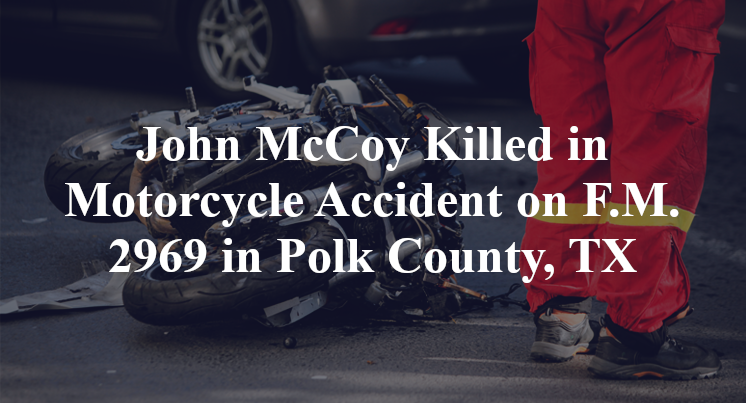
Officials indicate that, for reasons yet to be confirmed, the motorcycle failed to safely maintain its lane of travel. It was consequently involved in a single-vehicle collision in which it apparently overturned. McCoy reportedly sustained fatal injuries over the course of the accident. Additional details pertaining to this incident are not available at this point in time. The investigation is currently ongoing.
Commentary by Attorney Michael Grossman
When a rider loses their life in a single-vehicle crash, it’s easy to frame it as a tragic loss of control and move on. But that framing can leave behind critical unanswered questions—especially when the cause is still unclear. A fatal crash on a rural road deserves a deeper look.
1. Did the authorities thoroughly investigate the crash?
In rural areas, especially with single-vehicle incidents, investigations often rely on surface-level observations. But a motorcycle leaving its lane and overturning isn’t just a result—it’s a symptom of something that needs to be understood. Did investigators trace the bike’s path, measure skid marks, or document any signs of evasive action? Was there any obstruction, animal, or surface condition that could have triggered the crash? Without detailed scene reconstruction, much of that vital context may already be lost.
2. Has anyone looked into the possibility that a vehicle defect caused the crash?
A Harley-Davidson veering off course could be the result of a mechanical or stability issue. Was the front fork assembly intact and responsive? Were the tires or wheels compromised? Did a brake seize up unexpectedly during a maneuver? These aren’t theoretical problems—motorcycles depend on finely tuned systems, and a failure in any one of them can send a rider off balance in an instant. A full mechanical inspection is essential in any fatal case.
3. Has all the electronic data relating to the crash been collected?
Some Harley-Davidson models carry limited onboard diagnostics, and in many cases, riders use GPS systems or phones that track speed and location data. If any of those were active, they could offer insight into speed, turn behavior, or sudden deviations. That data may also help determine whether the crash happened during an attempted maneuver or if the bike failed mid-ride. Without retrieving that information, the clearest parts of the timeline may be missing.
Crashes like this don’t always leave behind witnesses—but the vehicle, the road, and the data often do. When someone is lost in a single-bike incident, finding the truth isn’t just about closure—it’s about making sure no warning signs go ignored.
Takeaways:
- Fatal single-vehicle crashes demand full scene analysis to understand the vehicle’s final path.
- Mechanical failures, especially in steering, braking, or tire systems, must be closely examined.
- GPS or onboard data may offer critical clues about what the rider and bike were doing before the crash.

 call us
  Email Us
  Text us