
UPDATE (October 10, 2025): Recent reports have been released which identify the motorcyclist who lost his life as a result of this truck accident as 35-year-old Hector Santiago-Cardona. No additional information is currently available. Investigations continue.
Urbana, IL — September 10, 2025, one motorcyclist was killed and another was injured in a truck accident just before 7:30 p.m. on Cunningham Boulevard.
According to authorities, two people riding motorcycles were traveling in the vicinity of the Cunningham Avenue and I-75 eastbound on ramp intersection when the accident took place.
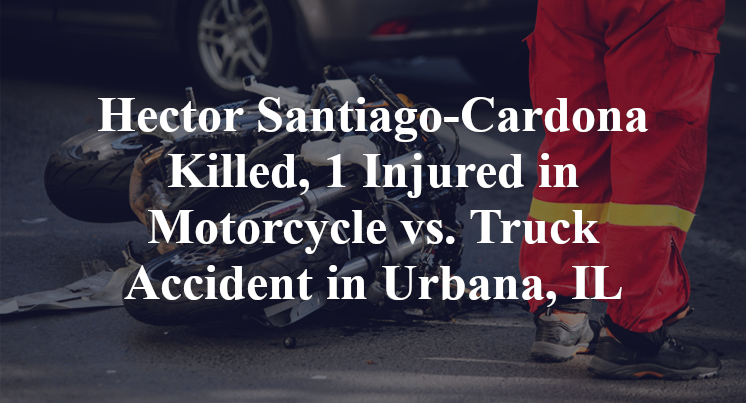
Officials indicate that an 18-wheeler attempted a left turn at an apparently unsafe time, failing to yield the right-of-way to oncoming traffic. A collision consequently occurred between the 18-wheeler and the two motorcycles.
One of the motorcyclists reportedly sustained critical injuries due to the collision and was transported to a local medical facility by EMS in order to receive immediate treatment. However, they were ultimately unable to overcome the severity of their injuries, having there been declared deceased. The other motorcyclist suffered minor injuries, as well, according to reports, and was also taken in for care.
Additional details pertaining to this incident—including the identities of the victims—are not available at this point in time. The investigation is currently ongoing.
Commentary by Attorney Michael Grossman
Left-turn crashes involving 18-wheelers and smaller vehicles often come down to one core issue: did the truck driver have enough time and space to complete the turn safely? Reports here say the truck attempted the turn at an “unsafe time,” but that phrase leaves a lot of unanswered questions. Was the driver misjudging speed and distance, distracted, or trying to force a gap in traffic that wasn’t there?
Truck drivers are trained to account for the fact that their vehicles take much longer to clear an intersection than passenger cars. A miscalculation of even a few seconds can leave oncoming motorists with no escape route—especially motorcyclists, who don’t have the protection of a vehicle frame around them. That’s why black box data, dash cam footage, and intersection cameras (if available) are so important in reconstructing what the driver saw and did.
It’s also worth examining the environment. Was visibility limited by sun glare, traffic congestion, or the layout of the intersection? Did the driver have a clear line of sight, or was he relying on a quick glance? Those factors don’t excuse a failure to yield, but they do help explain whether this was a momentary lapse of judgment or a more reckless decision.
Beyond the driver’s actions, there’s the question of the trucking company. Did they properly train the driver on making wide turns in heavy traffic? Was the driver under pressure to meet a schedule that encouraged rushing through intersections? I’ve seen cases where unrealistic delivery demands directly contributed to drivers taking unsafe risks on the road.
Until investigators can piece together those details, we’re left with the broad outline of a crash that cost a motorcyclist their life. The real work lies in narrowing down why the truck entered the turn when it did, and whether that decision was just a mistake—or the result of deeper problems in training or oversight.
Key Takeaways:
- The central issue is whether the truck driver had adequate time and space to complete the turn safely.
- Key evidence—like ECM data, dash cam footage, and intersection cameras—will be crucial in reconstructing the decision-making.
- Environmental factors such as sightlines or traffic flow may have influenced the driver’s judgment.
- Company training and scheduling practices could also have contributed to unsafe decision-making.
- Accountability depends on a deeper look at both driver actions and the systems behind them.

 call us
  Email Us
  Text us