
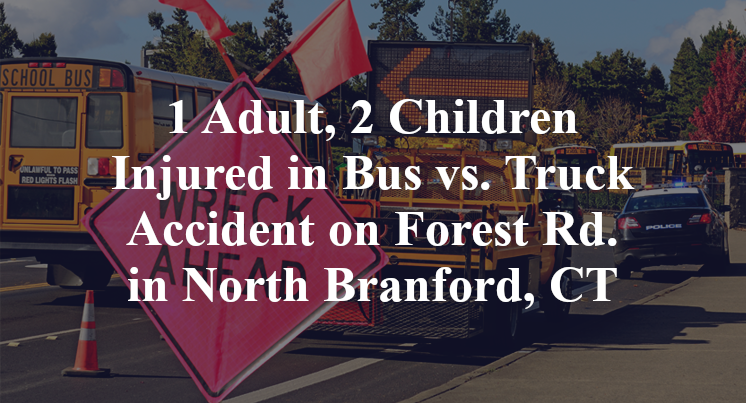
North Branford, CT — July 7, 2025, one adult and two children were injured due to a bus versus truck accident at approximately 2:00 p.m. along Forest Road.
According to authorities, a bus with two children on board was traveling southbound on Forest Road approaching the Mill Road intersection when the accident took place.
Mill Road ends with a stop sign at that T-shaped intersection and cross traffic does not have to stop. Officials indicate that, for as yet unknown reasons, a city truck attempted a left turn from Mill Road to head north on Forest Road at an allegedly unsafe time. A collision consequently took place between the bus and the truck.
Both of the children who had been on the bus may have been injured and were taken to a local medical facility by EMS for observation and any necessary treatment. The person who had been behind the wheel of the truck sustained minor injuries, reports state, and was also transported for care.
Additional details pertaining to this incident are not available at this point in time. The investigation is currently ongoing.
Commentary by Attorney Michael Grossman
When a city truck pulls into a busy T-intersection and a school bus with children on board can’t avoid a collision, the question investigators should be asking isn’t just who had the right of way—that part appears straightforward. The real question is why did the truck driver proceed when it wasn’t safe to do so?
Mill Road ends at a stop sign where traffic on Forest Road has the right of way. That puts the burden entirely on the driver at the stop sign to wait until the road is clear before entering. If the truck made a left turn into oncoming traffic, as reported, then it either misjudged the speed and distance of the bus or failed to see it altogether. In either case, that’s a failure of judgment—and possibly visibility—that could have had much worse consequences.
When children are involved, people understandably expect every precaution to be in place. But from a legal standpoint, the expectations for professional drivers—especially city employees operating commercial trucks—are high regardless of who the other vehicle belongs to. That includes checking for cross traffic with extra care, ensuring the path is clear, and never assuming another driver will yield in their favor.
The investigation should look closely at whether the turn was made hurriedly due to traffic pressure or time constraints. In cases I’ve worked, city vehicles were sometimes operating on tight schedules or under informal pressure to avoid delays, leading to rushed decisions at intersections. If that played a role here, it’s not just a driving mistake—it could reflect a broader issue in how city departments manage risk and prioritize safety.
Visibility at the intersection will also need to be examined. Was the view obstructed by trees, signs, or parked vehicles? If so, the truck driver had a duty to proceed with even greater caution. And if the driver couldn’t see clearly, the safe choice was to wait—not to guess.
Key Takeaways
- The central issue is whether the city truck made a left turn into oncoming traffic without a safe gap, violating the bus’s right of way.
- T-intersections with stop signs place full responsibility on the turning driver to yield until the road is clear.
- Investigators should examine whether pressure to stay on schedule contributed to a rushed or unsafe turn.
- Visibility at the intersection—due to obstructions or poor design—may factor into how the decision was made, but does not excuse it.
- Responsibility hinges on whether the turn was made with appropriate caution, as required of all professional drivers.

 call us
  Email Us
  Text us