
Lee County, FL — July 25, 2025, one person was killed due to a truck accident at approximately 4:30 a.m. along Joel Boulevard.
According to authorities, a 23-year-old was traveling in a southbound Ford F-350 on Joel Boulevard at the East 10th Street intersection when the accident took place.
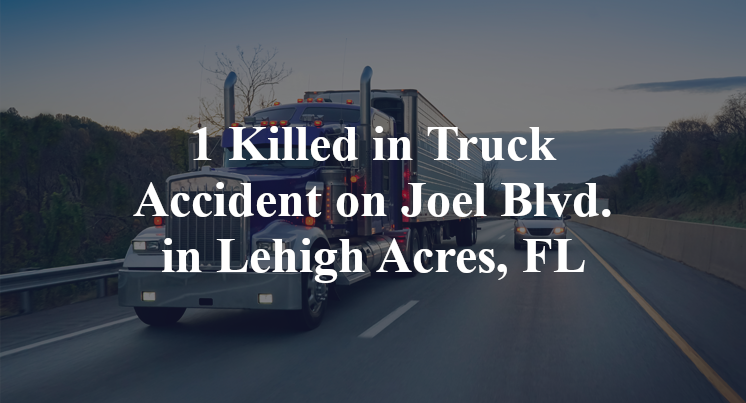
The intersection is apparently controlled by a two-way stop on 10th Street; cross traffic on Joel Boulevard does not have stop signs. Officials indicate that, for reasons yet to be confirmed, as an 18-wheeler hauling a flatbed tailer full of concrete slabs attempted a left turn from East 10th Street onto Joel Boulevard, the Ford collided with the flatbed trailer’s left side.
The person who had been behind the wheel of the Ford reportedly sustained fatal injuries due to the wreck and was declared deceased at the scene. Additional details pertaining to this incident—including the identity of the victim—are not available at this point in time. The investigation is currently ongoing.
Commentary by Attorney Michael Grossman
Crashes involving flatbed trailers often raise questions that go beyond simple right-of-way rules. In this case, the basic layout is clear: cross traffic on Joel Boulevard doesn’t stop, while traffic on East 10th Street does. That means any vehicle attempting to turn from East 10th—like the flatbed truck in this incident—has a duty to wait until the intersection is clear. So if the Ford had the right of way and still struck the trailer broadside, we need to understand how and why that situation unfolded.
One possibility is that the truck driver misjudged the available gap and tried to beat oncoming traffic. Another is that the trailer was moving too slowly or was partially blocking the roadway when it shouldn’t have been. In cases I’ve handled involving flatbed trailers, visibility is often a major issue—especially when the trailer is long, low to the ground, or carrying cargo that doesn’t reflect headlights well. If a driver can’t reasonably see that a trailer is crossing the roadway until it’s too late, even a right-of-way violation can become deadly.
In one case from my practice, a motorist swerved to avoid a truck that had pulled into his path at night, only to collide with an overhanging load that wasn’t properly lit or marked. That crash resulted in a fatality, and the jury didn’t just hold the driver accountable—they also assigned fault to the people who loaded the trailer and the company that allowed it on the road in that condition. That case showed how dangerous it can be when a trailer’s visibility or maneuverability is compromised, especially in low-light conditions.
If something similar happened here—if the concrete slabs, trailer configuration, or lighting made the trailer difficult to see—then the legal analysis won’t stop with whether the trucker failed to yield. It’ll also include whether the truck should have been attempting that turn at all under the circumstances.
Key Takeaways:
- The flatbed trailer entered a roadway where through traffic had no stop sign, raising immediate right-of-way concerns.
- Visibility of the trailer and its load—especially in pre-dawn hours—will be critical to understanding why the Ford didn’t or couldn’t avoid it.
- Past cases show that poorly marked or improperly loaded trailers can lead to shared liability among drivers, loaders, and trucking companies.
- Investigators should examine trailer lighting, cargo positioning, and turn timing to determine if the crash was preventable.
- Fault may extend beyond a simple traffic violation if the equipment or setup created an invisible hazard.

 call us
  Email Us
  Text us