
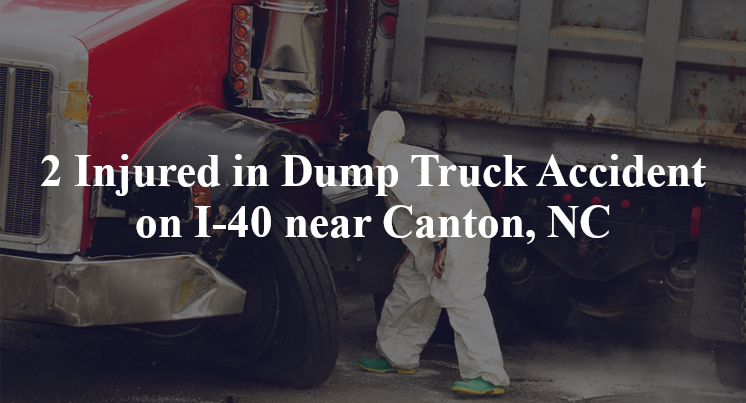
Haywood County, NC — August 7, 2025, two people were injured in a dump truck accident at about 1:40 p.m. on westbound Interstate 40.
Authorities said a dump truck crashed into the concrete median near Newfound Road when ones its tires blew out. The truck overturned and caught fire after the crash, spilling its load of gravel into the eastbound lanes.
The gravel hit an eastbound convertible, causing it to flip several times after the driver lost control, according to authorities.
Both drivers, whose names have not been made public yet, were hospitalized with non-life-threatening injuries, authorities said.
Authorities have not released any additional information about the Haywood County crash at this time. The accident is still under investigation.
Commentary by Attorney Michael Grossman
When people read about a dump truck overturning on I-40 and a convertible flipping in the opposite lanes, a natural question arises: How does something like that even happen? It’s not just about a blown tire or a pile of gravel: it’s about understanding what chain of events turned a mechanical failure into a dangerous multi-vehicle crash.
Authorities say a tire blew out on the dump truck, causing it to crash into the median, overturn and spill gravel across eastbound lanes. That gravel, in turn, caused an oncoming car to lose control and flip. On the surface, it sounds like a freak accident, but from a legal standpoint, it’s the beginning of a much deeper inquiry.
The central legal issue is whether the tire blowout was truly unforeseeable, or whether it was the result of preventable negligence. Tire blowouts don’t just happen without a cause. Common reasons include under-inflation, overloading, excessive wear or manufacturing defects. So the first set of questions that need answering are:
- When was the tire last inspected?
- Who was responsible for maintaining it?
- Was the truck overloaded or carrying improperly distributed weight?
These questions help determine whether the blowout was due to poor maintenance, bad loading practices or a defective product, each pointing to different responsible parties.
But the legal implications don’t stop with the tire. Once the truck overturned, its load spilled across lanes of traffic. That raises further concerns about the integrity of the dump body, how securely the load was contained and whether the truck had safety measures in place to prevent a spill across opposing lanes. Depending on how the gravel escaped the truck, this could involve questions about mechanical failures, improper use of a tarp system or inadequate driver response.
And what about the gravel-induced rollover in the eastbound lane? Was there enough time or space to avoid the debris? Could barriers have helped contain the spill? These aren’t just theoretical questions. They’re real factors that play into how liability is assigned and how future crashes can be prevented.
At the end of the day, this kind of crash may involve multiple layers of responsibility: the driver, the company that maintained the truck, the entity that loaded it and even the manufacturer of the tire. Without a thorough investigation that includes black box data, maintenance logs and inspection records, it’s impossible to say for sure who should be held accountable. But these are precisely the kinds of questions an experienced truck accident investigation must answer.
Key Takeaways:
- A blown tire may seem random, but it often points to issues like poor maintenance, overloading or manufacturing defects.
- Gravel spilling into oncoming traffic suggests a possible failure in how the truck’s load was secured or contained.
- Responsibility may lie with multiple parties — driver, trucking company, maintenance provider or tire manufacturer — depending on the findings of a detailed investigation.
- Evidence such as maintenance logs, black box data and load containment systems will be critical to understanding what really happened.

 call us
  Email Us
  Text us