

Columbia County, FL — February 27, 2025, One person was killed following an 18-wheeler accident that occurred at around 6:00 A.M. on County Road 238.
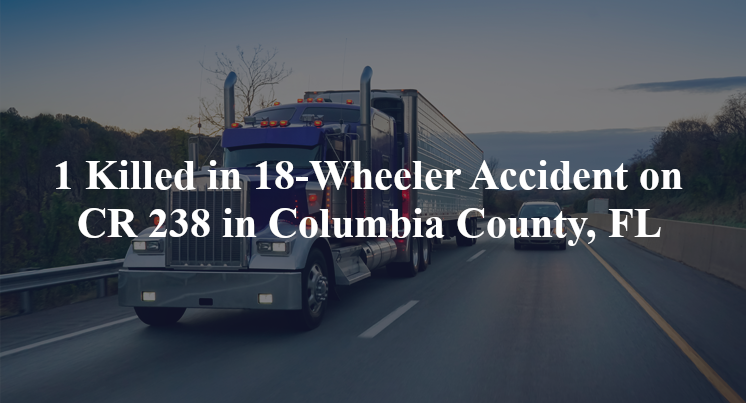
An investigation is underway into an 18-wheeler accident that left one person dead during the morning hours of February 27th. According to official reports, a 63-year-old woman was travelling on County Road 238 in the eastbound lanes when the vehicle passed through the SR 47 intersection where it was struck by an 18-wheeler, causing both vehicles to roll over.
When first responders arrived on the scene, they found that the woman had sustained fatal injuries and and she was pronounced deceased. At this time there has been no further information released about the accident, including the identities of those involved and whether any citations or charges will be issued, however this remains an ongoing investigation and more details may be released in the future.
Commentary by Attorney Michael Grossman
When people hear about a crash involving an 18-wheeler, they often assume that either the truck driver or the passenger vehicle driver made a critical mistake. While that’s certainly possible, my experience tells me that these crashes are often far more complex than they initially appear. Instead of making assumptions, it’s important to let the evidence guide the investigation. To do that, there are three key questions that need to be asked.
First, did the authorities conduct a thorough investigation? Law enforcement typically gathers crash scene evidence, interviews witnesses, and determines whether factors like traffic signals, visibility, or road conditions played a role. However, their ability to reconstruct a crash depends on their training and resources, which can vary from department to department. Given the severity of this crash and the fact that both vehicles rolled over, it’s critical that investigators carefully examine whether factors such as speed, braking distance, or improper turns contributed to the collision. If their findings don’t fully explain what happened, further expert analysis may be necessary.
Second, has anyone considered whether a vehicle defect played a role? Mechanical failures—such as brake malfunctions, steering issues, or transmission failures—can cause both passenger vehicles and commercial trucks to behave unpredictably. In some cases, a truck’s cargo may not have been properly secured, making the vehicle more prone to rollovers or loss of control. Diagnosing these issues requires a forensic examination of both vehicles, but too often, they are repaired or removed before experts have a chance to investigate. Preserving access to the wreckage is crucial to determining whether a defect or equipment failure contributed to the crash.
Finally, has all the available electronic data been collected? Both the passenger vehicle and the 18-wheeler likely contain electronic control modules (ECMs), commonly referred to as “black boxes.” These devices store key crash data, including speed, braking, and steering inputs leading up to the collision. Additionally, commercial trucks often have onboard telematics systems that may provide even more detailed information. Nearby surveillance cameras, traffic cameras, and dashcams may also hold valuable evidence. If investigators haven’t secured this data quickly, there’s a risk it could be lost or overwritten.
At the end of the day, answering these questions isn’t just about understanding what happened—it’s about ensuring that every possible explanation is considered. When a crash results in a fatality, the least the community can do for those affected is make sure no stone is left unturned in the search for answers.
 call us
  Email Us
  Text us