

Grand County, UT — July 6, 2025, one person was killed due to a two-truck accident at approximately 8:15 p.m. along Interstate Highway 70.
According to authorities, a 2024 Freightliner hauling a trailer loaded with blueberries made an illegal turn out of a scenic overlook in order to head eastbound on I.H. 70 near Crescent Junction when the accident took place.
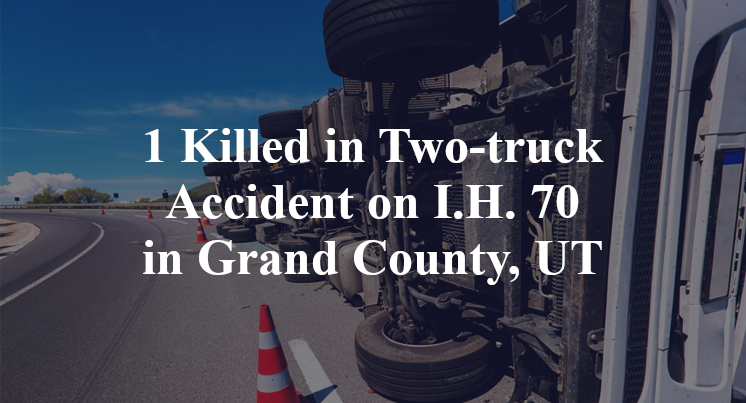
Officials indicate that an eastbound 2015 Freightliner collided with the rear-end of the one that had just entered the roadway, effectively destroying the trailer loaded with blueberries. The person who had been behind the wheel of the 2015 truck did not survive the collision, reports state. No other injuries have been reported. Additional details pertaining to this incident—including the identity of the victim—are not available at this point in time. The investigation is currently ongoing.
Commentary by Attorney Michael Grossman
When a truck driver pulls out illegally onto a high-speed interstate and another truck driver doesn’t survive the resulting collision, the central question isn’t who was at fault—that much appears clear. The real issue becomes: why was a turn like that even attempted? In commercial trucking, route planning and safe entry onto the highway are fundamental responsibilities. When those break down, the consequences are often immediate and irreversible.
In this case, reports suggest the 2024 Freightliner exited a scenic overlook and made an illegal turn to join the eastbound lanes of I-70. That detail alone raises several serious concerns. Scenic pull-offs are typically located on the right side of the roadway, and they’re designed with single-direction exits in mind. Turning across the median—or worse, against oncoming traffic—to rejoin the highway in the opposite direction is not only unlawful but deeply unsafe. A vehicle of that size simply cannot accelerate fast enough to merge safely into 70 mph traffic coming over a hill or around a bend.
That’s why the legality of the turn matters so much: it speaks directly to whether the driver followed basic operational rules. A professional driver is expected to continue to a proper on-ramp or make a legal turnaround, even if it adds time. Cutting across a highway from a stationary position violates both highway law and common sense.
It also raises questions about company oversight. Was this driver properly trained? Did they know the route, or were they improvising? In cases I’ve handled, seemingly simple wrong turns often trace back to poor dispatch instructions, lack of route planning, or pressure to make up time. If the carrier failed to provide safe routing or trained the driver inadequately on how to handle rest areas or pull-offs, then fault may not stop with the person behind the wheel.
The tragic loss of the second truck driver highlights the severity of this kind of error. A rear-end collision involving two commercial trucks at highway speed is rarely survivable for the driver who strikes a stationary or slow-moving trailer. That’s why commercial drivers are taught to assume that vehicles will be moving at or near highway speed—not entering the road from a full stop, especially in an unauthorized way.
Key Takeaways
- The key issue is why a commercial driver made an illegal and unsafe turn from a scenic overlook onto an active interstate.
- Trucks exiting from a stop cannot merge safely into highway-speed traffic without proper acceleration distance and a legal reentry point.
- This maneuver violated both traffic law and fundamental trucking safety standards, raising questions about training and route planning.
- The rear-end collision that followed was likely unavoidable for the eastbound driver, given the sudden and obstructive entry of the other truck.
- Investigators should examine not just the actions of the driver, but also the policies and planning systems that may have contributed to this fatal decision.
 call us
  Email Us
  Text us