

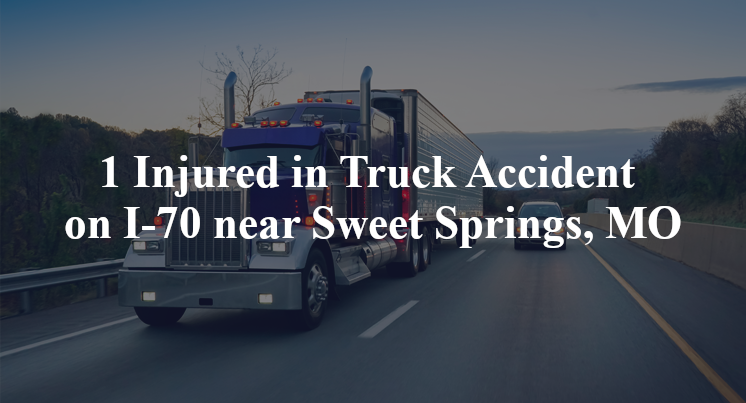
Saline County, MO — April 21, 2025, one person was injured in a truck accident at about 2:20 p.m. on westbound Interstate 70 near Sweet Springs.
Authorities said a 2023 Freightliner Cascadia semi-truck was stopped in traffic when it was rear-ended by a 2019 International semi-truck.
The driver of the second truck, a 33-year-old man from Belton, suffered serious injuries in the crash, according to authorities. He was flown to an area hospital for treatment.
No other injuries were reported.
Authorities have not released any additional information about the Saline County crash at this time. The accident is still under investigation.
Commentary by Attorney Michael Grossman
When one semi-truck rear-ends another in stopped traffic, it challenges the common assumption that professional drivers always have the space, time and training to avoid these types of collisions. The reality is that even in a commercial setting, crashes like this are often preventable, but when they happen, they raise serious questions about situational awareness, following distance and whether the driver was fully prepared for changes in traffic flow.
Commercial drivers are taught early on that space is their most valuable safety tool. Maintaining a proper following distance is critical not only for reaction time, but because of the sheer weight and stopping distance required to safely bring a fully loaded truck to a halt. If the lead truck was stopped for traffic, as reports suggest, then the second truck’s driver had a duty to anticipate that possibility and adjust speed accordingly. That expectation is even stronger on an interstate like I-70, where traffic patterns can shift quickly due to construction, congestion or crashes ahead.
The investigation will need to focus on whether the rear driver was distracted, fatigued or simply misjudged the distance to the stopped vehicle. Electronic control module data and dashcam footage will play an important role in determining how much time the driver had to react and what actions, if any, were taken in the final moments before the crash.
That said, the condition and visibility of the stopped truck also matter. Was it equipped with functioning brake lights and hazard signals? Was it stopped in a live lane or partially on the shoulder? While rear-end crashes generally place responsibility on the following driver, a poorly marked or unexpectedly stopped vehicle can complicate that analysis.
Ultimately, this crash isn’t just about which driver hit the other. It’s about whether both operators were upholding the professional standard that comes with handling 80,000-pound vehicles in highway traffic. When that standard slips, even for a moment, the consequences can be serious, even life-threatening. That’s why the goal of any investigation into a crash like this isn’t just to determine fault. It’s to understand whether the systems and decisions in place on that day lived up to the expectations the law, and the public, places on commercial transportation.
 call us
 Email Us
 Text us