

Summit County, CO — July 2, 2025, one person was injured due to a truck accident at approximately 4:15 a.m. along Interstate Highway 70.
According to authorities, the accident took place in the westbound lanes of Interstate Highway 70 in the vicinity west of the Eisenhower-Johnson Memorial Tunnel.
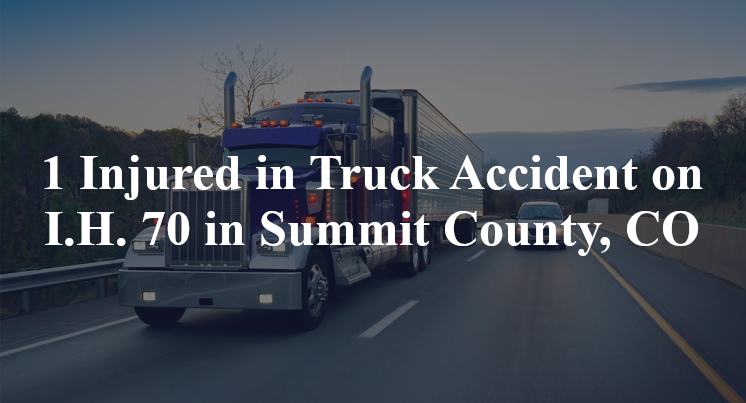
Details surrounding the accident remain scarce. Officials indicate that, for as yet unknown reasons, a collision took place between an 18-wheeler and a box truck. One person who had been involved reportedly sustained injuries of unknown severity. Additional information pertaining to this incident—including the identity of the victim—is not available at this point in time. The investigation is currently ongoing.
Commentary by Attorney Michael Grossman
When a crash occurs just west of the Eisenhower-Johnson Tunnel at 4:15 in the morning, it’s not enough to ask who hit whom—you have to ask what conditions existed that made a crash more likely at that specific time and place. Anyone familiar with that stretch of I-70 knows it’s not a typical highway environment. It’s a high-altitude corridor with steep grades, limited shoulders, and unpredictable weather. All of those factors matter when trying to understand how a collision between an 18-wheeler and a box truck occurred.
One key consideration here is braking and speed control. Westbound traffic coming out of the tunnel begins a sustained downgrade, which puts heavy strain on truck braking systems. If either vehicle was carrying a full load, it’s entirely possible one had to slow more abruptly than the other—especially if runaway speed became an issue. Investigators should be reviewing black box data from both trucks to determine speed, brake application, and following distance in the moments before the crash.
Lighting and visibility may also have been limited. At 4:15 a.m., you’re in pre-dawn darkness in a mountain corridor where sightlines are often reduced by curves, rock walls, or limited shoulder clearance. If either driver failed to account for those conditions—or didn’t have enough time to react to a slowing or stopped vehicle—that could shift the focus from outright negligence to insufficient margin for error.
Then there’s the mechanical side. Mountain driving exposes worn brake pads, underinflated tires, and suspension problems that might not cause issues on flat terrain but become dangerous on a downgrade. A post-crash inspection should look closely at both trucks’ mechanical condition to determine whether either vehicle was fit for that route at that time.
In my experience, early-morning crashes in high-altitude zones are rarely simple. They’re usually the result of a mix of environmental conditions, mechanical stress, and split-second decisions under pressure. That’s why a thorough investigation is essential—because what happened can’t be understood without knowing what those drivers were dealing with as they exited the tunnel.
Key Takeaways
- The crash occurred on a downhill stretch just west of the Eisenhower-Johnson Tunnel, where brake stress and speed control are critical.
- Black box data and braking system inspections will help determine whether either truck was descending safely and within control limits.
- Poor lighting, tight curves, and limited shoulders may have reduced reaction time or visibility just before the collision.
- Both vehicles should be inspected for mechanical issues, particularly those affecting downhill performance in a high-altitude corridor.
- Investigators must consider environmental and equipment factors alongside driver behavior to understand how the crash truly unfolded.
 call us
 Email Us
 Text us