

Houston, TX — May 20, 2025, one person was killed and another person was injured in a cement truck accident at about 1:35 p.m. at Cullen Boulevard and Shurmier Road.
Authorities said a cement truck ran a stop sign at the intersection and crashed into a passenger car.
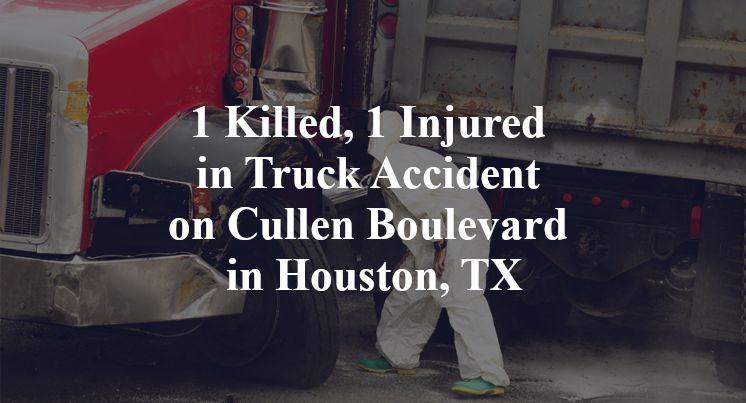
The woman driving the car died in the crash, while a passenger suffered unspecified injuries, according to authorities. Their names have not been made public yet.
Authorities have not released any additional information about the crash just north of the Sam Houston Tollway. The accident is still under investigation.
Commentary by Attorney Michael Grossman
When people hear that a cement truck ran a stop sign and crashed into a passenger car — killing the driver and injuring a passenger — the natural response is to ask, “How could that happen?” and “Was anyone watching the road?” Those are fair questions. But in my experience, the truth of what happened in a crash like this rarely comes out just because someone says the truck ran a stop sign. That’s only the beginning of the story.
Running a stop sign is a serious violation, but the bigger question is why it happened. Was the driver distracted? Tired? Did the brakes fail? Did they even see the stop sign? These are all possibilities, and the only way to answer them is through a careful review of the available evidence.
That evidence may include:
- Dash cam footage, if the truck had a front-facing camera.
- Cell phone records, which can show if the driver was texting or talking at the time of the crash.
- Engine Control Module (ECM) data, which can tell us if the driver braked, accelerated or was speeding.
- In-cab cameras, if installed, that might show whether the driver was alert or distracted.
Until someone goes after that data, the public can’t know whether this was just a mistake, or a failure of judgment, training, or even equipment.
If this truck was operated by a commercial company, there’s also a responsibility to ask what kind of oversight that company exercised. Was the driver properly screened before hiring? Were they trained adequately? How many hours had they been driving that day?
I’ve handled cases where the driver who caused a crash had a history of violations but was hired anyway. In one case, the trucking company’s so-called “driver test” took just 20 minutes and didn’t simulate real-world conditions. That’s not good enough. When a company hires someone to operate an 80,000-pound vehicle, they owe it to the public to do their homework.
Right now, we know very little beyond the fact that someone’s life was cut short, and another person is recovering from injuries. Authorities say the investigation is ongoing, and until more information is released, there are still important unanswered questions:
- Was the truck speeding as it approached the intersection?
- Did mechanical failure play a role?
- Was the driver under the influence or medically impaired?
- Did any surveillance footage capture what happened?
Each of these details matters. And while many people assume the truck driver is automatically to blame, accountability can only be determined after a full investigation, not before.
Key Takeaways:
- A crash involving a cement truck running a stop sign raises critical questions about why the truck didn’t stop.
- Evidence like black box data, dash cams and driver phone records can shed light on the events leading up to the crash.
- The trucking company’s hiring and training practices may also be relevant, depending on what the investigation reveals.
- Blame should not be assigned until all the facts are known.
- A thorough investigation is necessary to hold the right parties accountable.
 call us
 Email Us
 Text us