

Fresno County, CA — May 1, 2025, one person was injured in a truck accident at about 4 p.m. on Interstate 5/West Side Freeway near Coalinga.
Authorities said two semi-trucks collided near Jayne Avenue, knocking the first truck off the highway and into a utility pole. Another semi-truck hit the truck that had made contact with the first truck, as power lines fell onto the road, shutting down the highway in both directions for about six hours.
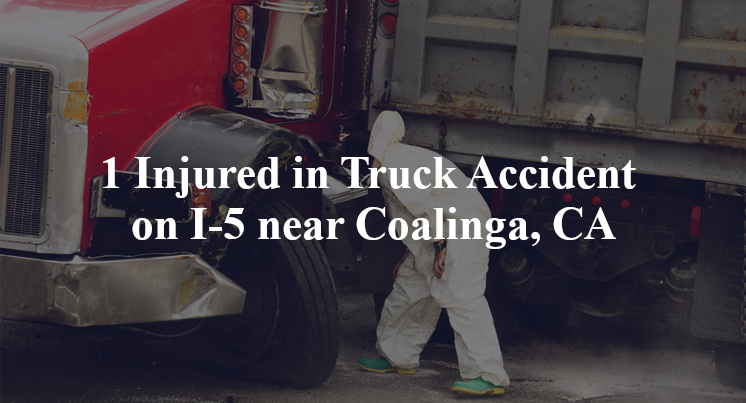
The driver of the first truck was flown to an area hospital with major injuries after the crash, according to authorities. The driver’s name has not been made public at this time.
Authorities have not released any additional information about the Fresno County crash at this point. The accident is still under investigation.
Commentary by Attorney Michael Grossman
When multiple semi-trucks collide on a major freight corridor like Interstate 5, and the result includes one truck leaving the roadway, hitting a utility pole and bringing down live power lines, the investigation must start with a clear look at spacing, speed and driver awareness. These are the fundamentals of safe commercial vehicle operation, and when they break down, especially among multiple trucks in a line of traffic, the results are often widespread and dangerous.
The fact that the initial collision led to a chain reaction involving at least one additional semi suggests that the trucks may have been traveling too closely for the conditions. Commercial drivers are expected to maintain longer following distances than passenger vehicles precisely because of their extended stopping distances and the weight and momentum of their vehicles. When one truck strikes another with enough force to force it off the road and into a power pole, investigators will rightly ask whether that following distance was appropriate, or whether distraction, fatigue or speed played a role.
It’s also possible that lane changes or merging activity near Jayne Avenue contributed to the crash. Interchanges and highway access points are common sites for truck-to-truck collisions when space is limited and timing misjudged. Investigators will need to review ECM data, available camera footage and physical markings on the road to determine whether the drivers involved had enough time and space to respond to each other’s movements, or whether one truck’s action created an unavoidable hazard for the others.
The involvement of a utility pole and live power lines complicates matters further. Not only does it increase the physical risk for everyone nearby, but it also suggests that the off-road trajectory of the first truck was severe. That’s the kind of result often seen when a collision occurs at highway speeds and the driver either loses control or is forced to take evasive action that couldn’t be recovered. Again, this points to a situation where proper lane spacing and situational awareness could have made the difference between a collision and a near miss.
The shutdown of a major freight route like I-5 for six hours is not a minor disruption. It’s an indication of how serious a failure this was in terms of both safety and logistics. When trucks are involved, the public cost of a single misstep is amplified, not just in terms of injuries, but in emergency response time, infrastructure damage and delayed commerce. That’s exactly why the law holds commercial drivers to a higher standard. Because the margin for error in these situations isn’t just small; it’s often nonexistent.
 call us
  Email Us
  Text us