

UPDATE (August 28, 2025): Recent reports have been released which clarify some of the details pertaining to this incident. According to these reports, contrary to what was originally reported in the news, this was a two-vehicle accident. Reportedly, a rear-end accident took place between the front-end of a Honda Accord and the rear-end of an 18-wheeler’s trailer. The man who had been behind the wheel of the Accord sustained fatal injuries, these reports state. No other people were hurt in connection with this accident. No further information is currently available. Investigations remain ongoing.
Travis County, TX — August 16, 2025, one person was killed and two were injured in a multi-vehicle truck accident sometime around 12:00 midnight along I-35.
According to authorities, the accident took place on the lower level of Interstate Highway 35 in the vicinity of 38 1/2 Street.
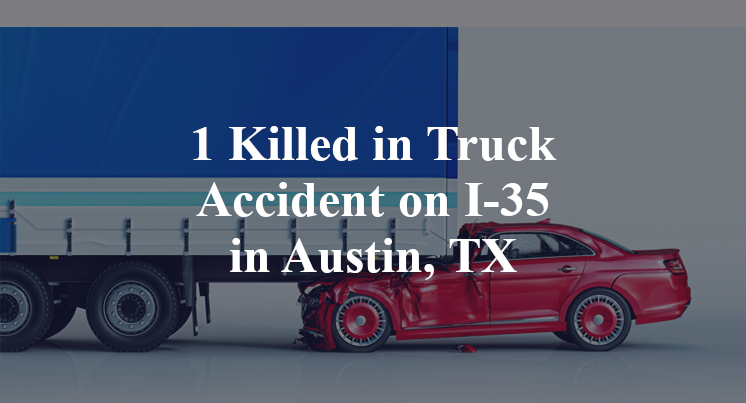
Details surrounding the accident remain scarce. Preliminary reports state that, for as yet unknown reasons, a collision took place involving three vehicles, one of which was apparently an 18-wheeler. One person who had been behind the wheel of one of the non-commercial vehicles reportedly sustained fatal injuries as a result of the wreck. Two other people suffered non-life-threatening injuries, as well; they were transported to local medical facilities by EMS in order to receive necessary treatment. Additional information pertaining to this incident—including the identities of the victims—are not available at this point in time. The investigation is currently ongoing.
Commentary by Attorney Michael Grossman
When a rear-end crash with an 18-wheeler leads to someone losing their life, it’s natural for people to ask: How could something like this happen? Who’s really at fault? And are we getting the full picture from the initial reports?
In this case, what’s been reported is that the front end of a Honda Accord collided with the rear of a tractor-trailer, resulting in the Accord driver’s death. But what hasn’t been reported—and what really matters from a legal and investigative standpoint—is what position the truck was in at the time of the crash. Was it traveling at highway speed? Was it slowing down? Was it stopped in traffic? Or was it pulled over on the shoulder or partially in a travel lane?
Each of those possibilities points to very different lines of inquiry. For instance, if the truck was parked or disabled without proper warning devices in place—like reflective triangles or flares—that could indicate negligence. If it was moving slowly or merging into traffic without working taillights or reflective markings, that’s another potential failure. On the other hand, if it was traveling normally and the car simply ran into it, that suggests a different chain of events entirely.
The point is, we don’t yet know which of these scenarios applies. And without that information, assigning blame—either to the car driver or the truck driver—is premature.
That’s why investigators must dig deeper. Key evidence would include the truck’s ECM data (its electronic “black box”), which can show its speed and braking patterns. In-cab cameras could clarify what the driver saw and did. Dash cams from other vehicles, if available, can help reconstruct the moments leading up to the impact. And if there’s any question about visibility—especially at night—it’s important to inspect whether the trailer had functioning lights and reflectors. I’ve seen cases where dirty, missing, or broken reflectors made the back of a trailer practically invisible.
In many of the rear-end truck crashes I’ve litigated, the difference between a clear case and a complex one often comes down to what evidence is collected—and whether it’s interpreted correctly. Trucking companies have responsibilities not just to operate safely, but also to maintain equipment, train drivers, and follow strict protocols in the event of a breakdown or roadside stop. Whether any of those factors played a role here remains unknown, but that’s exactly what a thorough investigation should uncover.
Key Takeaways:
- It’s not yet clear whether the truck was moving, stopped in traffic, or parked—all of which raise different legal and factual questions.
- Rear-end collisions with trailers often involve visibility issues, such as missing lights or damaged reflective tape.
- ECM data, dash cams, and post-crash inspections are essential for determining what actually happened.
- Responsibility doesn’t always rest with just one party; it depends on what the evidence shows about both the truck’s and the car’s actions.
- Until all the facts are in, assigning blame is premature—but the investigation must focus on uncovering the truth, not assumptions.
 call us
 Email Us
 Text us