

Chatham County, GA — April 22, 2025, one person was killed in a three-vehicle truck accident sometime before 9:00 p.m. along Interstate Highway 95.
According to authorities, the accident took place in the northbound lanes of I.H. 95 in the vicinity of the Quacco Road overpass.
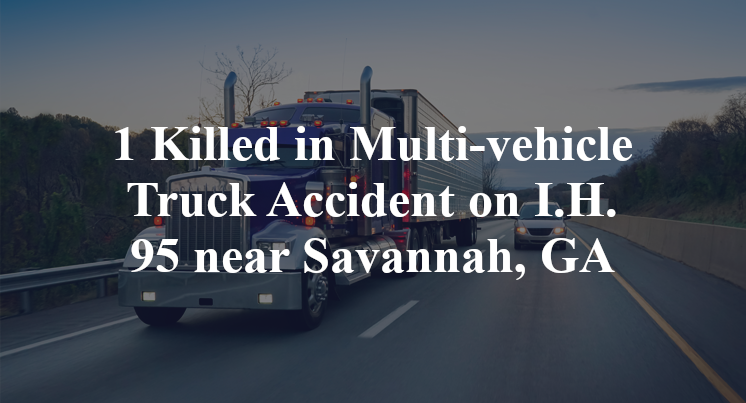
Details surrounding the accident remain scarce. Preliminary reports state that, for as yet unknown reasons, a collision took place between three separate vehicles, one of which was apparently an 18-wheeler.
One person reportedly suffered fatal injuries over the course of the accident. Reports do not say how many others may have been injured, as well. Additional information pertaining to this incident—including the identity of the victim—is not available at this point in time. The investigation is currently ongoing.
Commentary by Attorney Michael Grossman
In my experience, when a fatal crash involves three vehicles—one of them an 18-wheeler—the core question is rarely about who hit whom first. It’s about understanding the sequence of decisions and conditions that allowed such a collision to occur in the first place. On a high-speed corridor like I-95, particularly in the evening hours, visibility, traffic density, and vehicle spacing all play a major role in how these wrecks unfold—and whether they could have been avoided.
With limited details available, it’s too early to know exactly what triggered the crash, but there are some known patterns that should guide any investigation. Was one vehicle stopped or slowing suddenly? Was a lane change involved? Was traffic merging near the Quacco Road overpass? In multi-vehicle collisions involving a commercial truck, I’ve often found that what might have been a minor mistake becomes catastrophic when the truck behind isn’t given enough time—or doesn’t have the capacity—to react.
That’s why the truck’s speed, following distance, and lane positioning will be central to this investigation. An 18-wheeler requires far more distance to stop than a passenger car, and it has substantial blind spots that make it harder to track smaller vehicles nearby. Professional drivers are trained to account for those limitations. When they don’t—or when company policies push them to take risks to stay on schedule—the results can be devastating.
If the 18-wheeler was operating under a commercial carrier, the company’s role also deserves close scrutiny. Was the driver properly rested and in compliance with hours-of-service rules? Was the truck maintained appropriately—especially its braking and safety systems? Was the vehicle equipped with technology like forward-collision warning or automatic braking that might have helped prevent or reduce the impact? These aren’t minor details—they often tell the real story of how a crash like this came to happen.
From where I sit, any crash involving a commercial truck and resulting in a loss of life should be treated as more than just an unfortunate incident. It’s a sign that something—whether behind the wheel or behind the scenes—went seriously wrong. A thorough investigation will need to uncover whether that failure was an individual error, a systemic oversight, or something in between. Only then can the right parties be held accountable and those affected by the wreck receive the clarity and closure they deserve.
 call us
 Email Us
 Text us