

Baltimore County, MD — April 8, 2025, one person was killed and three others were injured in a multi-vehicle dump truck accident at about 3:30 a.m. along I.H. 95.
According to authorities, a 51-year-old was traveling in a southbound Jeep Cherokee on Interstate Highway 95 in the vicinity of Interstate Highway 695 when the accident took place.
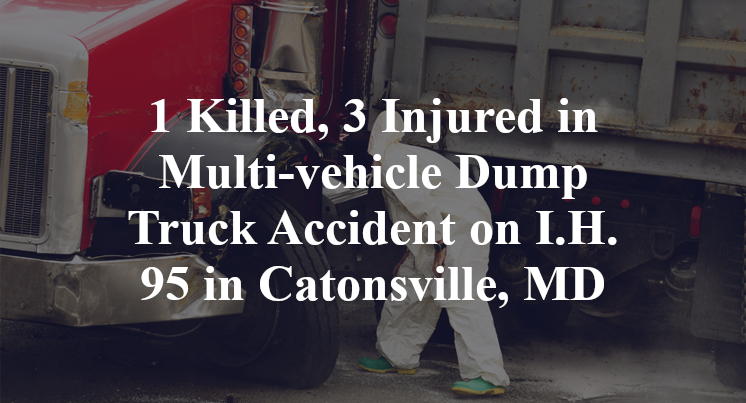
The cause of the accident remains unclear. Officials indicate that, for as yet unknown reasons, a collision took place between the front-end of the Jeep and the rear-end of a dump truck. The person who had been behind the wheel of the Jeep apparently exited the vehicle and was hit by a Subaru.
Three other people who had been involved in the wreck reportedly suffered injuries of unknown severity, as well; they were each transported to local medical facilities by EMS in order to receive necessary treatment. Additional details pertaining to this incident are not available at this point in time. The investigation is currently ongoing.
Commentary by Attorney Michael Grossman
In my experience, when a crash between a passenger vehicle and a commercial truck sets off a chain of additional collisions—especially at night or in the early morning hours—it’s usually a sign that critical safety steps were missed. Commercial vehicles like dump trucks carry an even greater responsibility in these situations because of their size, limited maneuverability, and the heightened danger they pose if they become stationary obstacles in active lanes of traffic.
At this stage, it’s unclear why the Jeep struck the rear of the dump truck, but that detail alone raises important questions. Was the dump truck moving at the time, or had it slowed or stopped in a live lane without proper warning? Were its lights, reflectors, and other safety equipment working as they should? Commercial vehicles are required to maintain their equipment to ensure they’re visible and predictable to approaching drivers, especially on high-speed interstates like I-95.
Beyond that, if the dump truck was operating under a commercial carrier or municipal contract, there are even more layers that need to be explored. Was the driver properly trained to operate safely during nighttime or low-visibility conditions? Was the truck where it should have been, traveling within the flow of traffic, or creating an unexpected hazard? And was the vehicle itself maintained according to the standards that the law demands for heavy commercial equipment? These are the kinds of questions that will ultimately shape any assessment of fault and responsibility.
From where I sit, a crash that leads not only to a vehicle collision but also to a fatal secondary impact suggests serious gaps in the protective systems that are supposed to prevent harm. Whether those gaps were due to driver error, vehicle maintenance failures, or poor decisions at the company level, only a full investigation will uncover the truth. And only by doing that can the right parties be held accountable and those affected by the wreck receive the clarity and closure they deserve.
 call us
 Email Us
 Text us