

Montgomery County, MD — April 15, 2025, on person was injured in a single-vehicle dump truck accident sometime before 1:00 p.m. along Interstate Highway 495.
According to authorities, a dump truck hauling a load of gravel was traveling on Interstate Highway 495 in the vicinity of Clara Barton Parkway when the accident took place.
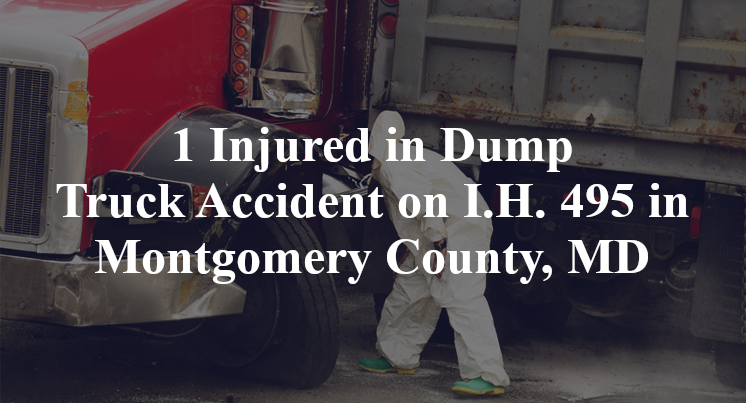
The cause of the accident remains unclear. Officials indicate that, for as yet unknown reasons, the truck was involved in a single-vehicle accident in which it overturned, coming to a stop resting on its right side, its cargo strewn across several lanes of the roadway.
Reports state that one person suffered injuries of unknown severity and was transported to a local medical facility by EMS in order to receive necessary treatment. Additional details pertaining to this incident—including the identity of the victim—are not available at this point in time. The investigation is currently ongoing.
Commentary by Attorney Michael Grossman
In my experience, when a fully loaded dump truck overturns on a major highway like I-495, it’s rarely a matter of simple bad luck. These trucks are designed to handle heavy loads, but they come with very specific requirements for balance, speed, and handling—especially when hauling loose materials like gravel. A crash like this raises immediate questions about how the truck was loaded, how it was being operated, and whether the conditions leading up to the wreck were being properly managed.
One of the most common factors in dump truck rollovers is improper load distribution. If the gravel was unevenly loaded or not properly secured, that can shift the vehicle’s center of gravity and dramatically increase the risk of tipping—especially during lane changes, sharp curves, or sudden steering corrections. Even something as routine as an evasive maneuver can go sideways fast when a dump truck isn’t properly balanced.
Speed and handling are also important pieces of the puzzle. Was the driver traveling too fast for the road design, traffic flow, or weight of the load? Was the truck entering or exiting a ramp, or reacting to something on the roadway? In cases I’ve handled, I’ve seen rollovers occur because drivers underestimated how much slower they needed to take curves or didn’t allow enough room to safely merge or brake. And when that kind of mistake involves a truck full of gravel, it’s not just a danger to the driver—it can turn an entire stretch of highway into a hazard for everyone else nearby.
If this dump truck was being operated as part of a commercial construction or hauling operation, the company behind it also needs to be part of the investigation. Were proper inspections conducted before the vehicle hit the road? Was the driver trained to handle the type of load they were carrying? Was the route appropriate for the weight and type of cargo? These are the kinds of operational decisions that often go unnoticed—until they lead to a crash.
From where I sit, a single-vehicle dump truck rollover is never something to gloss over. It’s a sign that something didn’t go as planned—whether that was a lapse in driving, equipment failure, or poor oversight of how the load was prepared and transported. That’s why a thorough investigation is essential to understanding what went wrong and whether it could have been prevented. Only then can the right parties be held accountable and those affected by the wreck receive the clarity and closure they deserve.
 call us
 Email Us
 Text us