

Terry, MT — April 14, 2025, One person was killed following an 18-wheeler accident that occurred at around 8:00 P.M. on S-253.
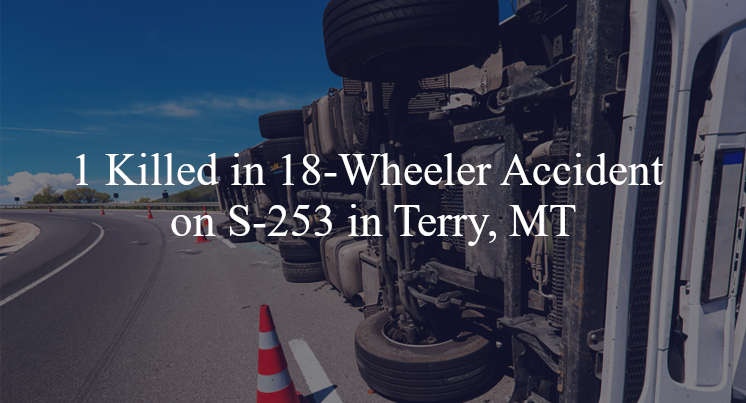
An investigation is underway following an 18-wheeler accident that left one person dead during the evening hours of April 14th. According to official reports, a 53-year-old man was traveling in a Peterbilt tractor-trailer on S-253 in the southbound lanes, when for unknown reasons the vehicle lost control and left the roadway where it struck a post before overturning on its roof.
When first responders arrived on the scene, they found that the driver had sustained fatal injuries and he was pronounced deceased.. At this time there has been no further information released from the accident, including the identity of the driver, however this remains an ongoing investigation and more details may be released by authorities in the future.
Commentary by Attorney Michael Grossman
When I read that an 18-wheeler left the road, hit a post, and flipped onto its roof—killing the driver—my first thought isn’t to guess what happened. It’s to ask, why did this happen, and what steps are being taken to make sure all the facts come to light.
I say that because when a report uses a phrase like “for unknown reasons,” it tends to stop people from asking more questions. But in my experience, we can’t settle for that. The phrase might mean investigators don’t have enough information yet—or worse, that they’re only looking at the crash scene and not digging into what led up to it. That distinction matters, especially in fatal truck crashes.
Now, some folks might assume that since the driver died, there’s no one to hold accountable. But that’s not how responsibility works in the real world. The most important question is: what conditions led this vehicle to lose control? And many of those answers lie outside the crash site.
Was there a mechanical issue with the truck? That’s something investigators can only answer if they retrieve the engine control module—the truck’s black box—and conduct a full forensic inspection. Was the driver dealing with fatigue, distraction, or a medical emergency? If so, things like cell phone records, dispatch logs, and trip history could provide those answers. And did the trucking company have the proper systems in place to monitor and evaluate the driver’s condition before he ever got behind the wheel?
I’ve seen cases where drivers were sent out on the road with unsafe equipment or under conditions that made safe operation next to impossible. I’ve also seen drivers put in tough spots because companies failed to train them properly or pushed them to meet unreasonable delivery schedules. Without knowing whether those factors played a role, it’s simply too early to call this an accident with no clear cause.
From where I stand, the most important takeaway is that “unknown reasons” should never be the end of the story. In any serious commercial vehicle crash—especially one involving a fatality—the questions can’t stop at the scene. They have to follow the evidence wherever it leads. Because only after a full investigation can anyone say with confidence what went wrong, and who, if anyone, failed to do their part.
 call us
 Email Us
 Text us