

Merrill, IA — December 20, 2024, One person was killed following an 18-wheeler accident that occurred at around 3:45 A.M. on Jackson St.
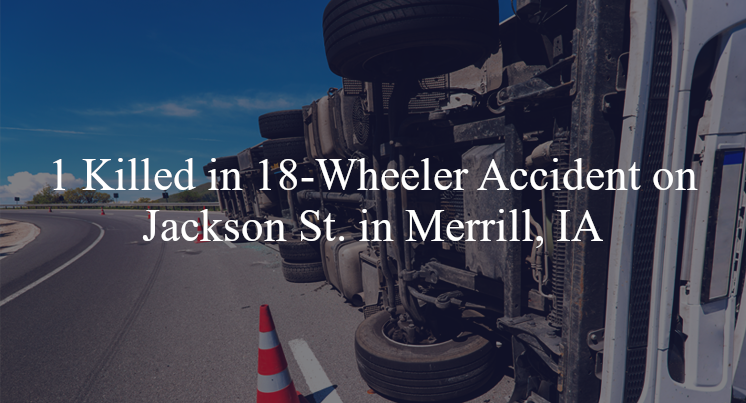
An investigation is underway following a car accident that left one person dead during the early morning hours of December 20th. According to official reports, the 18-wheeler was initially traveling in the southbound lanes of Highway 75 when for unknown reason the truck lost control and left the roadway at a curve in the road. The truck then went through the grass, passed through a parking lot, and eventually crashed into a tree on Jackson Street.
When first responders arrived on the scene they found that the truck had caught fire, and when the driver was evaluated he was found to have sustained fatal injuries and was pronounced deceased. At this time it remains unknown what caused the truck to lose control, and officials have not the identity of the driver, though as the investigation continues these details may be released by the authorities.
Commentary by Attorney Michael Grossman
When an accident involving an 18-wheeler results in a fatality, it is crucial to conduct a thorough and focused investigation to determine the cause and identify any contributing factors. Addressing three critical questions is essential in this process: Did the authorities conduct a thorough investigation? Has the possibility of a vehicle defect been considered? Has all relevant electronic data been preserved and analyzed?
The first question involves the thoroughness of the investigation conducted by law enforcement and other responders. When a truck loses control, leaves the roadway, and travels through multiple areas before crashing, many potential causes must be considered. Was the road properly designed and maintained, particularly at the curve where the truck lost control? Could environmental factors like poor visibility, road surface conditions, or signage issues have played a role? A detailed analysis of skid marks, tire tracks, and the truck’s path is necessary to understand how and why it veered off course. Independent investigations often provide additional insights beyond the initial findings.
The second question examines whether a mechanical issue or defect in the 18-wheeler contributed to the crash. Critical systems like brakes, steering, or suspension components can fail, particularly in large commercial vehicles that operate under heavy stress. Maintenance records should be reviewed to determine whether the truck was properly inspected and serviced. Additionally, incidents where the vehicle travels such a long distance out of control before stopping suggest the possibility of an issue with the braking system or load distribution. Post-accident inspections by qualified experts can identify whether mechanical failures played a role and whether the truck’s condition complied with federal safety standards.
The third and final question is whether electronic data from the truck has been preserved and analyzed. Most 18-wheelers are equipped with electronic control modules (ECMs) that record valuable information, such as speed, braking activity, throttle use, and engine performance. This data is critical for reconstructing what happened in the moments leading up to the crash. However, ECM data can be lost or overwritten if not promptly secured, particularly if the vehicle is moved or repaired. Preserving this information as soon as possible ensures that investigators have a clear picture of the truck’s operation.
Answering these questions requires collaboration among legal professionals, engineers, and accident reconstruction specialists. While initial reports provide a starting point, a deeper investigation is often necessary to uncover the full story. Each step, from examining the quality of the investigation to exploring potential defects and securing electronic data, is essential to ensuring that all contributing factors are considered.
By addressing these three critical questions, it becomes possible to determine what led to the crash and whether additional accountability is warranted. These efforts provide clarity and ensure that no relevant detail is overlooked.
 call us
 Email Us
 Text us