

Most personal injury cases are about making things right. You were hurt. You had medical bills to pay. You missed work and lost money. The goal is to recover those losses.
But sometimes, a case is about more than repayment. In those situations, punitive damages may come into play.
Punitive damages are extra money a jury can require a defendant to pay. They aren’t meant to reimburse you for hospital stays or time missed from work. They’re meant to send a message.
In Texas, punitive damages are awarded when a defendant’s conduct goes far beyond simple carelessness. The behavior must be so shocking and terrible that a jury believes punishment is necessary.
If punitive damages are awarded, the money goes directly to you, the victim. It doesn’t go to the government or anyone else. The purpose is to hold the offender accountable and to warn others that this type of conduct won’t be tolerated.
These damages are rare. They’re powerful. And they’re reserved for the absolute worst cases.
Punitive Damages Go Beyond Paying Medical Bills

In Texas law, punitive damages are often called “exemplary damages.” The name reflects what they’re meant to do: send a strong message that truly reckless behavior has serious consequences.
Punitive damages are stacked on top of compensatory damages. That means you must first prove your actual losses before punitive damages can be considered.
Compensatory damages cover losses like medical expenses, lost income, future care costs, pain, and mental anguish. Punitive damages don’t cover any of that.
Instead, they act more like a civil fine. They punish extreme misconduct.
The idea is simple. When someone acts in a way that shows total disregard for human life or safety, society wants to make a strong statement. Paying the victim back just isn’t enough in these cases.
Punitive damages show that society won’t tolerate awful behavior.
How Is Gross Negligence Different From Ordinary Negligence in a Personal Injury Case?
To truly understand punitive damages, you need to know the difference between ordinary negligence and gross negligence.
Ordinary negligence is simple carelessness. For example, a driver who looks at their phone and causes a crash, or a store owner who leaves a spill on the floor, would usually fall into this category.
These are serious mistakes, but they don’t reflect the extreme behavior required for punitive damages.
Gross negligence is way worse than ordinary carelessness.
Under Texas law, gross negligence refers to behavior that “shocks the senses.” It involves an extreme degree of risk and clear disregard for others’ safety.
In plain terms, it means the person knew the danger and didn’t care.
Imagine a workplace accident where a worker falls 60 feet to their death because proper safety equipment was never provided. Now imagine that instead of calling for help, the employer tries to cover it up. They rush out, buy a safety harness after the fact, and stage the scene to make it look like the worker was properly protected.
This is gross negligence, not ordinary carelessness. It shows a total disregard for human life.
What Makes Conduct Shocking Enough for Punitive Damages in a Personal Injury Case?
Not every serious accident qualifies for punitive damages.
To reach that level, the defendant’s actions have to be more than just bad judgment. They must involve a serious risk of harm and a clear decision to ignore that danger.
In many cases, jurors have a strong reaction when they hear what happened. They may feel shocked, angry, or deeply disturbed by the facts. The evidence may show that the defendant knew someone could get seriously hurt or killed and moved forward anyway.
Regular negligence is not enough for punitive damages to be awarded. Even serious injuries aren’t enough by themselves.
The focus is on the defendant’s state of mind. Did they understand the danger? Did they choose to ignore it?
If the answer is yes, punitive damages may be considered.
Do You Automatically Get Punitive Damages in a Personal Injury Case?
No. Punitive damages are never given automatically.
First, you must prove your basic personal injury case. That means proving four elements: duty, breach, injury, and proximate cause.
Duty means the defendant had a legal obligation to act safely.
Breach means they failed to meet that obligation.
Injury means you were actually harmed.
Proximate cause has two parts. Cause in fact means the injury would not have happened “but for” the defendant’s conduct. Foreseeability means the harm was something a reasonable person could have expected.
Only after proving all of that can you move to the next step.
Then you must prove gross negligence by presenting clear and convincing evidence; this is a higher standard than ordinary negligence.
The bar is really high for punitive damages. Many personal injury cases in Texas don’t qualify.
What Is the Difference Between Compensatory and Punitive Damages in a Personal Injury Case?
Compensatory damages are designed to repay you for what you lost.
They include medical bills, lost wages, loss of earning capacity, and future treatment costs. They also include non-economic damages such as pain, physical impairment, and mental anguish.
Texas courts recognize multiple categories of compensatory damages in serious injury cases.
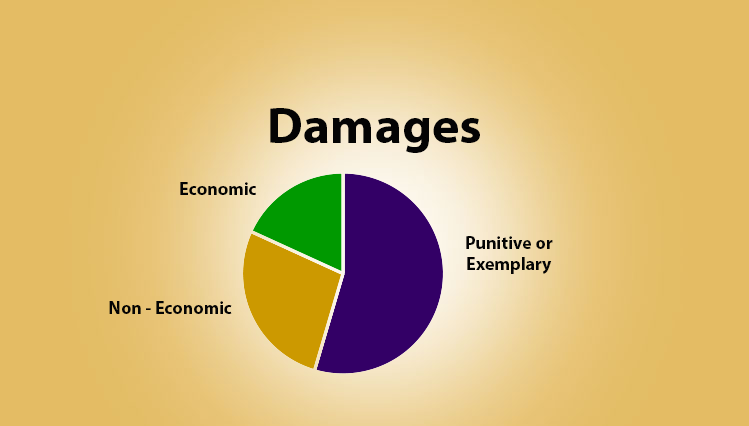
Punitive damages are separate, and they’re stacked on top of compensatory damages. They don’t compensate you for a specific loss. They punish the offender.
Punitive damages punish. Compensatory damages repay.
Are There Limits on Punitive Damages in a Personal Injury Case?
Yes. Texas law places strict limits on punitive damages.
The Texas Civil Practice and Remedies Code sets a formula that controls how these damages are calculated. So, you can’t ask the jury for any amount you want.
Lawmakers created these limits to balance punishment with fairness.
The judge must follow the statutory formula when entering the final award.
Is Getting Punitive Damages Like Filing an Insurance Claim in a Personal Injury Case?
No. It’s very different.
An insurance claim is eligibility-based. You submit forms, show proof of coverage, and the company determines whether they’ll pay.
A personal injury case is liability-based. You must prove someone else is at fault for your injuries.
Punitive damages require even more proof. You must file a lawsuit, conduct discovery, gather documents, question witnesses under oath, and more.
There’s no form for punitive damages. You have to go to trial. Having an experienced law firm on your side can make all the difference.
Who Decides Whether You Get Punitive Damages in a Personal Injury Case?

In Texas, the jury decides.
After hearing all the evidence, the jury decides whether the defendant’s conduct amounts to gross negligence. They hear how the accident happened, how serious the injuries are, and every detail about how the defendant acted before reaching their decision.
If they find gross negligence, they then decide whether punitive damages are in order.
If so, the judge applies the statutory formula and makes sure the award complies with Texas law.
Contact Grossman Law Offices With Any Questions About Personal Injury Cases
Punitive damages are powerful, but they’re very hard to win. These cases require strong evidence and a clear understanding of how to prove gross negligence.
You need an attorney who knows what it takes to build that kind of case.
For decades, Grossman Law Offices has fought for victims harmed by shocking and reckless conduct. Your lawyer will take the time to listen to your story, review the facts, and explain your options in plain language.
We stand beside you every step of the way.
Call Grossman Law Offices today. Don’t wait.

Reading Time: 5 minutesTake the first step toward justice and peace today.
Available for you 24/7

 call us
  Email Us
  Text us